This essay was originally published in the 1950 OCHS Yearbook. Please note that this essay was published over 80 years ago. While still useful for general education, language may be outdated and at times offensive. The Oswego County Historical Society does not stand by the language used in this essay. All photos were added in 2026 when this article was uploaded to the web. To view the original document, please visit NYHeritage.org.
Paper Given Before the Oswego County Historical Society By Frederick W. Barnes on Nov. 21, 1950.
Two years ago when Oswego celebrated its 100th anniversary as an incorporated city a great many people learned what an interesting place Oswego was and how varied have been its interests.
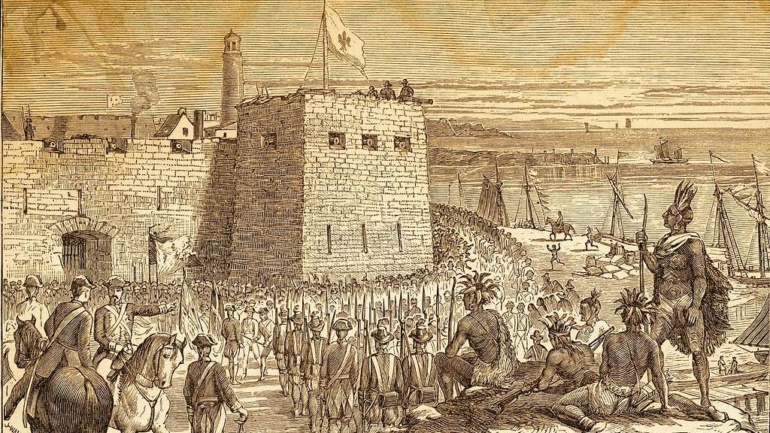
Beginning as a fur trading post, continuing as a military stronghold, afterwards in succession a port of entry, a hive of industry, an educational center and a developer of power on a gigantic scale. All this and more we of the present generation have reason to be proud of. Situated as we are at the point where a partially navigable river empties its waters into a great lake which on one hand is connected by the St. Lawrence River with the “Seven Seas” and on the other with the greatest reservoir of fresh water in all the world, it was only natural that the people of Oswego from the very beginning should have looked to their lake and to their river as the easiest means of transportation and as one of the important sources of subsistence.
It is not within the province of this paper to deal with Oswego’s commerce. Some phases of our commercial history have already been dealt with by abler pens than mine; but we should speak in passing of that great fleet of vessels which in the last 150 years has sailed in and out of this harbor; either carrying away or bringing to us, cargoes to or from other ports both near and far. We will merely remind you that the “Ontario,” the first steam driven craft west of the Hudson River, made its maiden voyage from Sackets Harbor to Oswego in 1817 and that only 24 years later the first screw propelled steamer on the Great Lakes, the “Vandalia,” was built in an Oswego shipyard.
Water Sports Developed Early
Someone has said that “All work and no play makes Jack a dull boy”, and it was but natural that the men of this locality from early times should have looked to the water as well as to the land for the kinds of sport that their primitive surroundings would permit. The Indians taught them how to build birch bark canoes and dug outs. Later they built boats of planks and drove them with sails. It was but a step from this to impromptu races and after a long time something like the modern yacht came into being. Just what is a yacht, do you ask? Well, generally speaking, a yacht is a pleasure craft to be used in cruising or racing and is usually driven by sails, by steam or by an internal combustion engine. There is such a thing as an ice yacht, but as far as I know this is a branch of the sport which was very rarely, if ever, indulged in by the people of this locality, so we will confine ourselves to water borne craft. We do not know who the first Oswegonian was to own and sail a yacht. He probably built it himself but if he needed help, it was available in as much as Oswego could boast of a shipyard with drydock as early as 1825. As cargo carriers were under construction here more than 100 years ago, it is reasonable to assume that pleasure craft did not follow far behind.
Early Ship Builders
I remember the late George Goble, who more than anyone else who has ever lived here, was associated with Oswego’s ship building industry. When I knew him, he was already far advanced in years; approaching the end of his career, but in his younger days, not he alone, but others were responsible for the activities of our lake front and the land bordering the Oswego Canal. The records show that in the year 1861 George Goble operated a marine railway at the foot of West Third Street and that this railway was of sufficient capacity to haul out any vessel or steam boat which could pass through the old Welland Canal. Goble had a stone workshop 160 feet long and three stories high; also another three story building equipped with steam engine and boilers. There was also a railway for canal boats alongside. Seventy five or more mechanics were employed at the Goble plant. Other ship yards or dry docks, which were operating locally at that time, were: The Oswego Dry Dock, owned by Lee Navagh and Company which was situated above the lower bridge; Kitts and Moore’s Ship Yard and Dry Dock located in the East Cove with a steam saw mill in connection and employing more than 100 men with an additional 40 men engaged in boat building. There was also the Scott and Nesbitt Dry Dock on the tow path of the Oswego Canal between Hubbard’s Tannery and Allen’s Morocco Factory where hundreds of canal craft were built. In addition to the foregoing enterprises, A. C. Mattoon had a dry dock on the East side below the lower bridge.
Lake And River Town
Up to this point, we have given our chief attention to Oswego’s activities along the line of boat building and boat repairing. So far, very little has been said about yachting but the point which I have been trying to impress upon my audience is that during a large part of the 19th century, Oswego was primarily a lake and river town. Its citizens transacted their business by water and traveled by water. Many of its residents were engaged in ship carpentry. Another large group was employed in forwarding or receiving by water, grain, salt, coal, starch, flour, lumber, etc. Many of its young men found employment during a large part of each year as sailors aboard the boats which were much more numerous then than now although much smaller.
During the season of navigation, Oswego owned and Oswego-manned boats were to be found on all the lakes while here at home a half dozen steam tugs were constantly in readiness to assist sailing vessels when the latter wished to enter or leave this busy harbor and when the bad weather did come in the late fall, there was always a goodly number of ship masters, who would decide to tie up here and make this their winter quarters. From 1820 to 1880 the people of Oswego were like everybody else where, busily engaged in trying to make money or at least attempting to earn a living.
Yachtmen’s Cruise In 1877
In the beginning, they had little time for recreation, but as things eased up with some of them, they turned to the lake as offering the greatest opportunity for adventure. In scanning the files of the “Oswego Palladium” for the year 1877, I found a news item, which I will repeat for your benefit. To those of us who are natives of Oswego, and old enough to remember the people of long ago, the names which are here given might seem to have been taken from some social register Nearly, if not quite all of them, belonged to families of more than ordinary prominence. The quotation from the 73 year old newspaper begins at this point: “The young gentlemen composing the A. H. M. Society left early this morning on yachts Sappho, Idler and Magic for a cruise among the Thousand Islands, a fishing and hunting excursion and a general good time. The yachtsmen were dressed in their handsome uni forms and looked exceedingly well. The Sappho’s crew started for the Duck Islands, where they will spend a couple of days; from thence to Alexandria Bay and then to Mary’s Island where they go into camp for two weeks. The crews of the Idler and the Magic go to Kingston to spend Sunday, from there to Clayton and Alexandria Bay and then into camp on an island adjacent to Mary’s Island. Everything necessary for the cruise and for camp life is safely stowed away in the boats and every precaution taken against accident.
Captain “Jimmie” Martin is the commodore of the fleet, and in that capacity, will have a fatherly eye out for the boys. Following are the names of the young gentlemen composing the crews of the different yachts—on board the “Sappho”—Sailing Master Capt James Martin, crew Will Pardee, Horace Shead, Theodore Page, Robt. Sloan and Tom Herrick. On board the “Idler”, Elliott Mott, Will Lee, Fred Wheeler and Delos Radcliffe, and onboard the “Magic”, Allen Ames, John Higgins and Dudley Irwin.”
Awful Homely Monsters
As previously stated, the names in the foregoing newspaper account were in practically every instance from families which ranked high in the Oswego of that day, both socially and commercially. There was, however, one youth whose name at that time was apparently too obscure to be printed but who later earned for himself a place in our local Hall of Fame. I refer to the distinguished writer, Morgan Robertson, who was aboard the yacht “Idler”. At the beginning of this same news item reference was made to a club to which the boys belonged. I have seen a photograph where nearly all of those mentioned were taken in a group picture. They were in uniform and on each uniform were the letters A. H. M. Nobody now living seems to know what the letters really stood for, although Mr. Elliott B. Mott is my authority for the statement that the sisters and the sweethearts of the yachtmen interpreted the initials as meaning “Awfully Homely Monsters” Society. For a period of 20 years beginning about 1880 the local interest in yachting became more and more pronounced.
The first serious attempt at organization was in 1881 when 70 Oswegonians subscribed $10.00 each to form a society called the Oswego Boat Club. The young men who formed this society felt that it was more tactful to say “Boat” rather than “Yacht” club inasmuch as the word yacht would have indicated sails, and their parents in many cases, looked upon row boats as safer than sail boats. As things turned out, however, this was but the opening wedge, for the very next year, 1882, the Oswego Boat Club became the nucleus of a much larger organization to be known as the Oswego Yacht Club.
Yacht Club Organized
The Oswego Yacht Club included in its membership not only residents of Oswego city but also men from all over Oswego county and some from outside. They needed a club house and one was built in 1883. It was located on the lake shore at the foot of West Fifth Street.* The site for the structure was leased from the D. L. & W. R. R. Company for a nominal sum.
One of the best known boats to have ever flown the flag of the Oswego Yacht Club was the “Katie Gray”. This yacht was built in Canada but was purchased and brought here by William B. Phelps, Jr., of Oswego. Mr. Phelps was an ardent yachtsman and although the “Katie Gray” was not designed for speed, her owner entered her in many regattas both here and across the lake. Mr. Phelps not only raced his boat but at other times he loved to cruise about the lake for the benefit of his guests and himself. He was frequently accompanied by his brother, John P. Phelps, another ardent yachtsman. In this connection I will add that after the death of William B. Phelps, Jr., the ownership and operation of the “Katie Gray” was assumed by his brother, John P. Phelps, who kept the boat in commission until about 1912. Two other yachts are associated in my memories with the Phelps brothers. One was called the “Phantom” and the other the “Kathleen”.
*This building is still standing on its original site.
Ames Skilled Helmsman
I have always felt that there were three families in Oswego who were outstanding in their interest in yachting. One of these, the Phelps family, has already been referred to. The other two were the Motts and the Ames. Those of us who were here fifty years ago and who took any interest in yachting will remember the name, Allen Ames. Mr. Ames was an ironmaster and an active member of the family which gave its name to Ames Iron Works. His hobby was yachting and his leisure hours were chiefly devoted to that sport. He liked to cruise, but above all, he loved to pit his skill as a helmsman against the best talent that could be found anywhere on Lake Ontario. He was rarely, if ever, beaten and his triumphs were chiefly associated with two boats, both of which had been expressly designed for him. The first of these was called the “Merle” and was designed by Burgess, who became distinguished as the designer of some of the fastest craft on our Atlantic seaboard . Burgess’ yachts, similar in model to the “Merle”, had previously and successfully defended the America’s Cup but a change was imminent. The “Merle”, like all Burgess’ boats had a movable center board which was a distinctly American idea as opposed to the fixed keel of the British yachts. This latter has been called the plank on edge design with much less beam and greatly increased depth of hull. Instead of the Yankee movable centerboard, the British depended upon a fixed keel that was not only deeper but was also weighted. In the beginning of the International races the advantage was almost always with the Yankee centerboard but as we have just seen, a change was imminent.
Allen Ames was one of the first to read the handwriting on the wall. His beloved “Merle” was no longer fast enough. About this time, there appeared in far off Scotland a man named Fife. Yachting journals and sporting columns began to hold his name up for adulation as a designer of racing craft. Nothing was too good for Oswego, so Capt. Ames commissioned Fife to design a yacht for him.
“Yama” Designed By Fife
This celebrated boat called the “Yama” was designed in Scotland, built in a Long Island shipyard and brought to Oswego. It has been said of the “Yama” that she was the fastest boat of her inches on fresh water and that she was never beaten in a fair race. It has also been said that her great success both in American and Canadian waters was due largely to Allen Ames’ skill as a helmsman backed up as it always was by the crew of Oswego boys whom he had trained. With your permission I will again quote from a newspaper of the period. This time it is from the “Oswego Palladium” and the date is July 17th, 1892:
“Yesterday’s defeat of the yacht ‘Zelma’ of Toronto was an event that Capt. Ames may well be proud of. It must be remembered that both yachts were designed by Fife, the great Scotch designer. Two years ago the ‘Yama’ was launched and her sailing was a revelation to lake yachtsmen. It often happened that she defeated larger boats in higher classes. She made such a record that Fife, her designer, came all the way from Scotland to sail upon her and see her sail. When Norman B. Dick of Toronto, the owner of the ‘Zelma’, placed an order with Fife, it was with the understanding that she would be able to out sail the ‘Yama’. It is said that Fife replied that he could not design a boat the same size as the ‘Yama’ that he would guarantee would outsail the Ames yacht but that in his opinion a boat might be built which would be a little longer and with more beam that would outsail the Oswego boat. The order was placed and the ‘Zelma’ is the result.
In designing the ‘Zelma’, Fife had the ‘Yama’s’ lines before him. He had seen the ‘Yama’ sail, had sailed aboard her and knew just about what she could do. With all this knowledge at his command, Fife went to work on the ‘Zelma’. She was framed in Scotland and when she was just to Fife’s notion of what a world beater should be, the frames were taken down and shipped to Toronto. That Mr. Dick has received from the hands of the great Scotch designer a fine yacht there is no question. She is undoubtedly a very speedy boat although she has yet failed to take a race from the ‘Yama’ in a yachtsman’s breeze. Yesterday was a day that suited both boats. Neither had the advantage. The wind was fresh from start to finish and the ‘Yama’ won.
“Yama” Versus “Zelma”
“The ‘Yama’ was not in first class condition during the races. Just before the starting gun was fired she came into collision with the steam cutter ‘Vreda’. The chain plates on the ‘Yama’ were carried away, her rail was lifted up and two or three planks were stove in through which the water came in. When the race was over there was about eight inches of water in the hold which constituted a draw back to good sailing. It is evident that those on the Toronto yacht were aware that the race would be a struggle from start to finish and accordingly, prepared for it. The ‘Zelma’s’ cabin was cleared of bedding and furniture. There was not even a partition left standing in order that the yacht might be in the lightest possible trim. Aboard the ‘Yama’ also, bedding and furniture were removed but the partitions were left standing.
“The protest against the ‘Yama’ by Capt. Dick for what he called ‘fouling’ the ‘Zelma’ was not allowed by the Regatta committee. In his protest Capt. Dick stated that the ‘Yama’, while holding a windward position by the wind, dropped down close to the ‘Zelma’ for the purpose of blanketing the latter in violation of the sailing rules. The committee heard the protest and decided that when the ‘Yama’ established an overlap she had the right of way and, therefore, the protest should not be allowed. When the ‘foul’ was claimed both yachts were beating to the windward buoy and almost touched each other. The ‘Zelma’ is three feet longer overall than the ‘Yama’ and 18 inches longer on the water line. The ‘Zelma’ also has 15 inches more beam. After the race, Capt. Ames sailed his boat around to the Goble dry dock to have repaired the damage caused by the collision with the ‘Vreda’.
“H. C. Witherington of South Brooklyn, the builder of the ‘Yama’, was delighted with the race. He had traveled 350 miles expecting to sail on the ‘Yama’ but was knocked overboard by the collision with the ‘Vreda’. Capt. Ames started immediately to rescue him but Witherington, who is a powerful swimmer, called out for the ‘Yama’ to proceed on her course and the plucky man was picked up almost at once by the crew of another boat.”
Lake Racing Association
Each succeeding year it was the job of the Lake Ontario Yacht Racing Association to fix the dates of the different Regattas. These Regattas would be held in mid-summer and would be carefully chosen to suit the convenience of the different clubs. There would be a Toronto Day, an Oswego Day, a Kingston Day, etc. The yachts were divided into different classes according to size and as no two were exactly the same size there was what was called “time allowance” with the larger boats allowing something to the smaller boats of the same class. Although I am a landlubber, and nearly all of my sailing has been confined to big ocean steamers, this does not mean that I was not personally interested in yachting in general and the activities of the Oswego Yacht Club in particular. “Regatta Day”* in Oswego was something that I used to look forward to.
The yachts from the other clubs would sail into our harbor one after another, usually the day before the races, and each one would take up its appointed station. The spectacle as presented to anyone standing on the bluff at the foot of West Sixth Street was an interesting one. After lowering sails and dropping anchors each boat would run up a number of small flags attached to its rigging. In the evening before race day it was customary to hold a dance at the Yacht Club House which would be one of the social events of the season. While the dance was in progress some of our citizens, embarked in small boats, would dot the waters of the harbor as they rowed in and out between the yachts whereas the yachts themselves were made gay with colored lanterns.
*The last Regatta Day held in Oswego by the Lake Ontario Yacht Racing Association was held in 1928 with the Oswego Yacht Club acting as host. The fact that there were few perceptible winds for several days, interfered with the races for several days, but the occasion proved a social success with many yachtsmen present from New York State and Canadian clubs.
Ten Mile Course
The races were held outside the breakwater where buoys were anchored to mark the course. These buoys were 3 1/3 miles apart, so placed as to form a triangle. Theoretically to cover such a course outside the buoys meant a ten mile lap but in reality, the distance covered was more than ten miles. Even a land lubber like myself knows that a sailing vessel never proceeds very far in a straight line and is sometimes blown away off its course. It was customary for the smaller contestants to sail twice around such a course but for the larger yachts three times around was the usual practice. The starting line and home buoy were located not more than one half mile outside the breakwater where we would sometimes, quite enthusiastically, row out to the breakwater and spend hours watching the start and sometimes the finish while in between, the monotony would be broken as yacht after yacht would be rounding the home buoy at the end of the first and second line.
Many people have thought and still think that yacht racing has little or nothing to offer to the spectator but personally I would rather see a well contested race of this kind than any horse race that was ever run. We must admit that in spite of the active interest in yachting which was at one time displayed by Oswegonians and by the residents of a few other New York State towns, that as far as Lake Ontario was concerned, we must yield the palm to our neighbors across the lake. The Canadians built more boats and took an even greater interest in the sport than we did but when it came to deep sea yachting, it was a somewhat different story. Taking the United States as a whole, we had the advantage of greater numbers and possibly of greater wealth. These handicaps, however, did not deter the Canadians from challenging for the America’s Cup.
The America’s Cup
I wonder how many in this audience would know what is meant by the America’s Cup? There were periods of from 25 to 70 years ago when the newspapers gave a great deal of front page space to the America’s Cup. In 1851 an American yacht called the “America” crossed the Atlantic Ocean under her own sail and won a race in competition with a number of English yachts. This victory entitled the owner of the ‘America” to a silver trophy which ever since or for a period of 99 years has been known as “the America’s Cup.” The British, naturally would not accept their defeat as final and have sent a good many boats to America in attempts to recover the prized trophy. There have been Scotch challengers, English challengers and among the more recent was the gallant Irish con tender, Sir Thomas Lipton who made several attempts “to lift the cup” as the saying goes but so far the “Yankees” have been a little too clever or a little too lucky and the cup still rests in the vaults of Tiffany & Company, where it was placed for safe keeping. Up to date more than one million dollars has been spent by the challengers and the defenders in this contest of contests.
Cup Challenger Here
What has the America’s Cup got to do with Oswego? Do you ask? Not very much but there is a slight connection. In 1876 a Canadian by the name of Cuthbert backed by a Toronto syndicate designed and built a yacht called the “Countess of Dufferin” and sailed her to New York by way of the Gulf of St. Lawrence and the Atlantic Ocean. This long and, for a small boat, somewhat hazardous voyage was made in order that the Canadian yacht might race against an American defender of the America’s Cup. Our boat won but Cuthbert and his associates were not easily discouraged, so in 1881 they tried again with a new boat especially designed for the occasion as the first boat had been. The second boat was called the “Atalanta” and instead of going via the Gulf of St. Lawrence this boat took the shorter and more sheltered route to the seaboard by way of Oswego and the Erie Canal. The “Atalanta” had a little too much beam to pass through our canal locks, so they resorted to pontoons and raised one rail higher than the other. The “Atalanta” laid up in Oswego for a few days while enroute. I remember seeing her as she was tied to the dock just North of the lower bridge on the West side of the river. Again the American boat won and the Canadians have not tried since then. Mr. Cuthbert was well known in Oswego. He sailed in and out of this port many times and was considered a great authority on everything pertaining to Lake Ontario yachting.
In addition to the annual regatta under the direction of the Lake Ontario Yacht Racing Association, there were from time to time other races which were sailed over the Oswego course and in which Oswego yachts were usually the only participants. In the “50 years ago” column of the “Palladium Times” for the 10th of last August was a brief account of a race for something called the “Anchor Cup” which was sailed here just 50 years before on August 10th, 1899. Among the contestants were two boats and their owners whose names I have seen elsewhere but in a different connection. One of these yachts was called “Venus” owned by Charles Smith and the other was the “Caprice”, owned and sailed by Arthur Emerich.
Old Time Yachtsmen Steam Yachts Too
I would like to insert at this point a list of yachtsmen and their boats who were active in local yachting circles between 1885 and 1920. Kindly remember that the list is far from being complete and that no attempt has been made to enter the names in their chronological order.
We will begin with James Parker, who not only sailed boats but also built them and we can credit him with the construction of three pleasure crafts, each of which, in its turn flew the pennant of the Oswego Yacht Club. The earliest of the Parker boats was christened “Dolphin”. The second was the “Theresa” and the third “Theresa II”. Then there was the “Nautilus”, owned by William Coad and the “Ella”, which was the property of Nelson Stone. The “Ella” was probably the fastest of the Oswego fleet with the exception of the Allen-Ames yachts. The Littlefield family owned a large two masted yacht called the “Rhoda” which was ideal for cruising. We must not omit the “Fascination” or the “Laura”. This last named boat was owned by a group of Oswego business men of whom Robert Gordon, Jr., was one. There was another schooner rigged yacht owned by Capt. Vickery of East 10th Street and called the “Lottie Blair” and the “Stella,” built by a man named Burke. Fred Murdock, the tinsmith, built his own yacht, the hull of which was constructed entirely of sheet iron and very appropriately christened the “Scrap Iron.” Then there was the “Santa Maria”, the property of John F. Otis, and the “Kittie O’Shea”, owned by Martin Higgins. There were others whose names have escaped me but I will close the list with the “Bessie”, owned by C. J. McDowell, and the McGlannon yacht, “Ethel”, formerly of Rochester bought in 1885 by three Oswego yachtmen and brought here to make a valuable addition to the Oswego fleet. Many years ago someone said that “the most beautiful sight in the world is a square rigged ship under full sail”. Be that as it may, the lines of the average yacht are indeed graceful. There are exceptions to all rules and 70 years ago there was in Oswego a yacht so rudely designed that it was generally known as “The Potato Bug”. There was another name but as no one used it (unless the poor owner may have done so) we all forgot what it was. In addition to a large fleet of sailing yachts the Oswego Club could boast of several steam yachts only three of which I can remember. Two of these were the property of the Conde brothers. Swits Conde owned the “Ruth” and Frederic Conde the “Corinthian” whereas James Macfarlane’s steam yacht was named the “Aida”. All of these boats were originally operated on salt water.
Advent Of The Motor Car
Looking back to the turn of the century one can see very definitely that the advent of the automobile had much to do with the gradual decline of the interest in Lake Ontario yachting. I do not wish to be understood as saying that there are no longer any pleasure craft to be found on this lake of ours. To the contrary let it be said that in the busy port of Toronto are to be found a number of cabin cruisers nearly all of which are equipped with Diesel engines while in the smaller Lake Ontario harbors are still to be found a goodly number of men who own and operate a pleasure boat of some sort but with the exception of an occasional international match in which a yacht from Rochester or Watertown is pitted against a Toronto boat there is no general interest in Lake Ontario yacht racing. Long before the motor car had almost completely revolutionized transportation something happened in Oswego which for the time being at least put a damper upon yachting as a form of recreation.
A Marine Tragedy
I refer to the tragic death of Charles Ames which occurred on June 24th, 1900. “Charley” Ames as his friends called him was the grandson of Leonard Ames, the first, one of the founders of Ames Iron Works. Charley’s own father, Leonard Ames, Jr., and Allen Ames were half brothers. You will remember that Allen Ames was the one who brought so much glory to Oswego with his celebrated yacht the “Yama”. On the day of his death Charles Ames and his young wife (Charles was about 29 years old) had invited a few friends (both men and women) for what was to be a short sail in Charley’s own small yacht called the “Bohemian”. It was after dark but the lake was calm and Charley was a good sailor. He knew how to handle a boat. All went well until Charley surrendered the tiller (temporarily as he thought) to one of his guests while he stretched out on top of the deck house. He may possibly have fallen asleep but at any rate the yacht came up suddenly into the wind while the boom switched sharply from one side to the other knocking Ames into the water. He was a good swimmer and life preservers were thrown overboard where he was supposed to be but in the darkness and confusion all attempts at rescue failed and he was drowned.
As I remember it this tragedy marked the end of the Ames family’s interest in yachting. Allen Ames and his brother, Alfred Ames, took part in no more races and the “Yama” and “Bohemian” were sold to out of town parties. Even without this deplorable occurrence there would have been a gradual decline in yachting interest due principally as we have already noted to the advent of the automobile but although the public in general must have heard somewhat less about yachting and racing was much less popular than it had been, cruising continued to occupy the attention of certain individuals who found this form of recreation more to their liking than any other.
Col. Mott’s “Papoose”
In this connection the first name that occurs to me is that of John T. Mott. The late Col. Mott probably more than any one else was responsible for the success of the Oswego Yacht Club. Again and again he was called upon to serve as its commodore and his active connection with local yachting interest extended through a period of at least 50 years. His first boat was called the “Cricket” and much later he sailed the “Papoose”. This last named yacht was brought from Boston. During the period in which Col. Mott sailed the “Papoose” he had in his employ a man who was known as Capt. Phil Barclay. It would frequently happen that Col. Mott would have guests and if not and accompanied only by Barclay he would cruise to wherever his fancy took him.
Col. Mott, as some of you will remember, was one of our leading bankers and he also took an active interest in politics. Although he was a very busy and useful man, he found in sailing a means of rejuvenation and he kept it up as long as he could but although he lived to an advanced age the time came when he felt that his sailing days were over and if he did not do something about it his faithful yacht might fall into un appreciative hands so he decided to dispose of it in an original way. Barclay beached the “Papoose” at a suitable place along the lake front and at its last resting place the “Papoose” was set afire and completely consumed, except for the lead keel the material of which could still be made to serve some useful purpose. We have all heard of faithful horses or dogs who have been put to death by their master for fear that the beloved animals should meet with neglect or ill treatment but this is the only instance that I can think of where an inanimate object has been similarly disposed of.
Judge Calkin An Enthusiast
When I undertook this job at the request of your society I did not realize how many boats or how many men were entitled to a place in such a history. It is probable that what I have tried to do is not more than half done and that as many more should be here recorded. One such name fresh in the memory of all Oswegonians is the late Francis D. Culkin. Judge Culkin was a much younger man than Col. Mott, like the colonel, enjoyed cruising and owned and personally sailed one after the other no less than three cruising yachts. For a period of years he served as commodore of the Oswego Yacht Club.
During the most recent 15 years with the exception of the owners of a few very small sailboats it may be said that there is no one interested in Oswego as a yachting center. Our neighboring harbor of Fair Haven has been the home port of several pleasure craft which are owned here but seldom come here. It is possible that when “Uncle Sam” completes the extensive enlargement of the Oswego Harbor which is now under consideration that it will bring about a renewed interest in pleasure craft but until then we in Oswego must be content with a fleeting glimpse of a luxurious cabin cruiser probably owned in New York City as it passes through Oswego by way of the Barge Canal either going to or coming from the St. Lawrence river.
A Marine Adventure I can think of nothing more to say regarding Oswego as a yachting center but perhaps you will bear with me a little longer while I try to recapture something which occurred here many years ago and although no yachts were involved it took place on the water and might be called a marine adventure. Sometime between 1875 and 1885 the Federal Government built an artificial island and placed it at the mouth of the river just outside the entrance to our harbor. It was a piece of crib work which means that there was a framework of heavy timbers bolted together which was weighted down and held in place with stones. I should judge that it might have been 12 feet above the water and about 60 feet square. It was locally known as “the block” or the island. It was really a breakwater and the idea was to break the force of the waves when caused by an on shore wind which would otherwise have an unobstructed drive up the river.
Instead of being as intended a protection to shipping it proved a menace particularly to those vessels which entered the harbor at night. After it had been there for a few years the government removed it. One year while it was still there the people of Oswego decided to celebrate the Fourth of July in a new way. Instead of reading the Declaration of Independence in the West Park with ice cream, and fireworks in the evening the committee in charge decided to stage a boat race but it would not be in the lake where comparatively few could see it but in the river where thousands of people might at least have a glimpse. It was decided to have a sculling match. We have not had a rowing or sculling match in Oswego in a long, long time but they have them in Syracuse and in a good many other “varsity” towns.
The varsity races are rowed in what are called racing shells and it is customary to have at least four oarsmen to a shell and in addition one other man called the coxswain who guides the shell. Such shells are long and narrow, pointed at both ends, light draft and no weight to speak of. In addition to those shells which are propelled by four or more oarsmen there are others which are built for a single oarsman and the Fourth of July contest of the long ago was for single oarsman, one man to a shell who not only had to propel his unseaworthy craft but also to steer it.
Sculling Race
There was at that time at least one of these racing shells owned in Oswego. It was the property of a professional sculler whose name I think was Joe Handley (I am not sure that that was his name). Joe owned a boat livery in Oswego where he kept row boats for hire and during a part of each summer he would compete in sculling matches on Lake Onondaga, Cayuga Lake, the Hudson River and on other lakes and rivers which were not too far away. Joe was on the Oswego Independence Day committee and he was also one of the contestants The other contestants came from away and in order to secure their participation cash prizes were offered for whosoever should come in first and second. The course was laid in our Oswego river just North of the lower bridge and the oarsmen had to row to the mouth of the river, around the artificial island, which I have described, and back to the starting line at the lower bridge. Fortunately it was a very calm day otherwise that part of the course which circled the island would have been too hazardous for such a frail craft. As it was I think one of the shells did capsize but there were no casualties. Joe Handley, the local boy, did not win and I cannot remember who came in first but it must have been either Courtney of Cornell or Riley of Rochester. The race was witnessed by a great crowd of spectators who lined both sides of the river from the bridge to the piers and out on the piers which were there then but have since disappeared. The bridge itself was a popular point of vantage and as I remember it a limited number of spectators were permitted to line the railing on the bridge’s North side. Our small police force assisted by the Life Savers (now called Coast Guardsmen) the sheriff and his deputies, also the Fire Department were in readiness if needed but there were no unfortunate incidents.
In closing I wish to acknowledge my indebtedness to Messrs. Elliot B. Mott of Oswego and Thomas C. Goble of Valley Cottage, Rockland County, New York, who supplied names and dates which otherwise might not have been available.