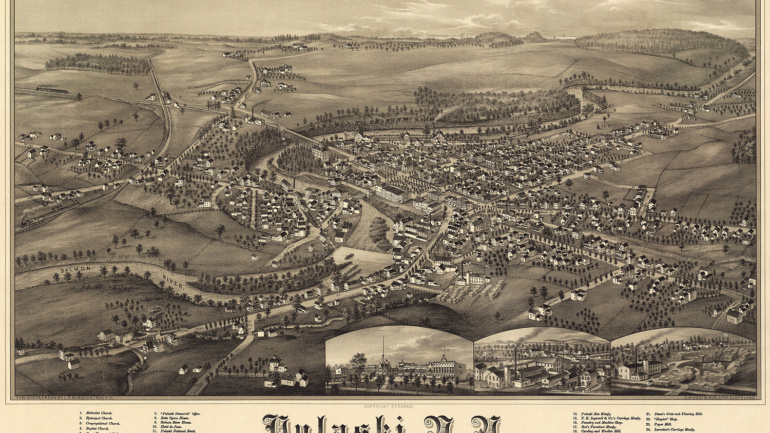
This essay was originally published in the 1948 OCHS Yearbook. Please note that this essay was published over 80 years ago. While still useful for general education, language may be outdated and at times offensive. The Oswego County Historical Society does not stand by the language used in this essay. All photos were added in 2024 when this article was uploaded to the web. To view the original document, please visit NYHeritage.org
Paper Head Before Oswego County Historical Society at Oswego October 19, 1948 By Mrs. Edwin M. Allen of Oswego—Formerly of the Faculty of Oswego State Teachers College
Part I
Trying to condense some 150 years of a town’s colorful growth into a concise story is a task which could not be entirely covered in one paper. Many things will be left unsaid. No history can be as warm and friendly as were those people who made that history.
I am deeply indebted to those residents of Redfield who opened their doors to me, sent me information which they possessed and gave generously of their time to help make this paper possible. I would like to acknowledge in particular the help of some of the people who were especially cooperative, namely Mr. and Mrs. William J Aloan, Mr. and Mrs. Dean Williams, Mr. John Clemens, Mr. Fred Anken and my father, David Brown, who did much of the leg work.
It is a pleasure to speak of Redfield, my home town and birthplace.
Early Settlement
Redfield, New York, located in the Salmon River Valley and bordering on the Tug Hill Plateau, was one of the earliest and most flourishing settlements in Oswego County. Captain Nathan Sage, a Connecticut sea captain, was one of the leading pioneers in Redfield. He and a few other Connecticut men located there between the spring of 1795 and the autumn of 1797 and sent back favorable accounts concerning the fine, level flats on the Salmon River, the virgin soil which then appeared very fertile, the vigorous growth of timber and the pure, clear water which could be found everywhere.
Immigration began in earnest in 1798 and thirty two new families came to settle making Redfield the most populous township at that time, having thirty two residents assessed for the payment of taxes to twenty six in all the rest of the area now known as Oswego County.
In 1798 the settlers were undecided as to the permanent name that should be given their community, some favoring naming the town Redfield after Dr. Frederick Redfield who had bought a huge tract of land there, and some favoring the name of Strickland after another large land holder. However, circumstances settled the debate for the pious New Englanders as Mr. Strickland ran away with another man’s wife and Dr. Redfield died. Deciding that Dr. Redfield, being dead, couldn’t commit a similar offense, they christened the town Redfield.
The territory from which Redfield was erected has a long and complicated history. It was conveyed by the State of New York to Alexander Macomb by patent on January 10, 1792, as part of a two million acre tract at eight cents per acre. He, in turn, sold his holdings to a man named Constable who journeyed to Paris to sell the land. Later Constable sold his interests to Thomas Boylston but due to inability of the latter to complete his payments the land later reverted to Constable. My home was located on the Constable tract and the deed referred to the land as “part of the Boylston tract.”
No less complicated was the surveying of Oswego county. The land was successively included in the counties of Albany, Montgomery, Herkimer, Oneida and Onondaga before it became Oswego County. On March 14, 1800, the town of Redfield was officially formed and application was made to the legislature for its creation as a town. The request was granted and Redfield eventually became the second oldest township in Oswego County, with Mexico enjoying the distinction of being the oldest.
Early Government
On April 1, 1800, the voters began to organize for government. They met at a neighbor’s house and elected the following officers: Supervisor, town clerk, three assessors, collector, two overseers of the poor, three commissioners of highway, constables, three path masters, three fence viewers and a pound master.
This governing set up was followed until about 1920 when the duties of path masters, fence viewers and commissioners were combined under one officer known as the town superintendent of highways. The rest of the offices with the exception of that of pound master continue to be known under their original names. The local dog catcher is the present day successor of the early pound master.
At this time these civic minded pioneers also gave fifteen acres of land to the young town for public purposes. It was laid out as a public square and given the name of Centre Square. However, it was soon abbreviated to “the Square” and is now known as Redfield Square. They also gave an additional acre for a burying ground.
The Square has always been the meeting place of the townspeople of Redfield. During these early times for a rostrum an immense hemlock standing on the Square was cut off some twenty feet from the ground and a platform was built on the stump to accommodate the officials and election “stump speakers” of the day. From that elevation on many an Independence Day orators thundered forth their eulogies of American liberty and their denunciations of despotism in every form. Nearly every Fourth of July saw an enthusiastic celebration when bowers covered with bushes or tree branches from the neighboring forest were built in the public square and long tables, capable of accommodating every man, woman and child in the town, were spread with food produced by the farms round about.
The town residents also made certain needed local laws at this meeting which resembled the Connecticut “town meetings” to which the pioneers had been earlier accustomed. Among the laws which was voted was one providing a penalty of five dollars for felling trees into the Salmon River unless they were immediately afterwards cut out. A bounty of five dollars was also voted for each wolf killed in the town. Fences were decreed to be four feet high, the part under three feet to have but six inch spaces between the rails. Hogs were voted as “free commoners” and allowed to run at large, but cattle were to be shut up and the pound was to cost the townspeople sixteen dollars. At the same time they voted to have the highway commissioners open the “great road” with money raised by the town.
Business Interests
Farming was the principal Redfield occupation at this time. According to the records of one of the earliest justices of the peace, the price for a day’s work with an ox team harrowing and logging, was nine shillings—a dollar, twelve and a half cents
In 1800 the first saw mill and the first grist mill were built. The latter was abandoned after a few years and the inhabitants were forced to go to far away Rome for their grinding or to resort to the primitive stump mortar.
The first tavern was opened in 1800 by David Butler. However, the proprietor did not enjoy his monopoly long as that same year along came Amos and Joshua Johnson. Amos started the second tavern and Joshua became the first minister, thus the brothers attended to both the spirituous and spiritual needs of the townspeople.
At about this time Dr. Enoch Alden came from Rome and made his home in Redfield. His infant son was the first occupant of the newly laid out graveyard.
In 1807 the survey township of Acadia (Greensboro) was annexed to Redfield, making a total of 58,800 acres of land in the expanded township. As no one lived in Acadia the only effect was to raise the amount of taxable property.
In the same year on April 1, 1807, the first post office was established in Redfield.
Education And Religion
With the machinery for government in action and the business interests established, the people turned their attention to education and religion. The first school of which any account can be obtained was taught in the winter of 1801-1802 by the Rev. Joshua Johnson. The first church, Congregational, was organized in 1802 by Mr. Johnson with nineteen members and this was unquestionably the first church organization effected within the present county of Oswego.
Travel
In 1799 the state road was opened from Rome to Sackets Harbor. It was finished by the soldiers during the War of 1812. Much travel passed over this road and during the war bodies of troops were constantly passing. Folklore has it that on one occasion a company camped on the public square while the young ladies of Redfield were gathered at a quilting party. The captain approached and politely inquired if the girls would dance with his men. In a few minutes the soldiers and maidens were dancing on the green of the village square.
In 1795 the population of Redfield had stood at thirty eight. In 1800 it rose to one hundred forty one. After the War of 1812 and the improvement of the road immigration again grew greater. By 1840 there were 507 and in 1870, when the peak was reached, Redfield had 1,324 inhabitants. The state road was largely responsible for this rise as the road connected the Mohawk and the St. Lawrence River Valleys. An important stage coach line developed and mail and salt were carried over this route. The road is often referred to today as the “Old Salt Road”.
Redfield After The War Of 1812
The people still retained their interest in education and in 1817 and 1818 voted to raise for schools three times the amount received from the state. This was much more than surrounding towns were then raising.
At the same time the prevailing general ideas regarding the expenditure of public money were very frugal. In 1818 it was voted that the commissioners of highways should treat with those of Orwell for the building of a bridge across Salmon River but should not expend over thirty dollars for that purpose!
However, the people were alert to any legal protection which they deemed necessary. They boosted the five dollar bounty to twenty dollars for each wolf killed and provided a fifty cent bounty on foxes. They also decided to curb their “free commoners” and voted that the hogs should have rings in their noses between April 1 and December 1, and lacking these necessary ornaments a fine of twenty five cents each would be imposed upon their owners.
In 1824 the people built their first church building a Methodist Church, and in 1829, not to be outdone, the Congregationalists erected a church. These two churches still stand on either side of “the square.”
About 1835 the first store in town was opened although certain goods had been purchasable at a neighbor’s house ever since 1810. Following the influx of people two large tanneries were opened in 1855. These increased the business of the town and employed about fifty men besides offering a market for quantities of hemlock bark cut from the trees in the forests which still surround the village. These industries tanned about 30,000 hides each year. The company ran its own store for employees and by so doing was able to reap back much of their wage output.
Bails Of Wood
With the tanning industry came the demand for better means of marketing goods. About 1865 a railroad from Williamstown village, built for the purpose of carrying lumber and wood, was extended into the town of Redfield within two and one half miles of “the Square.’ The rails themselves were fashioned of wood. Up until 1871 the railroad did a heavy business and an immense amount of wood was cut and carried off. After that time wood became less abundant though the road was kept in operation until 1876 when it was abandoned and the tracks were taken up.
One of the biggest enemies from which the townsfolk have never had adequate protection robbed them of their tanneries— fire! Fire destroyed one of the tanneries early in its career and on the night of Cleveland’s election to the presidency the other tannery burned. Fire still continues to rob Redfield land holders annually and farm buildings once destroyed are seldom rebuilt.
Greensboro Short Lived Town
Up until 1830 there had been almost no settlement in Acadia. The “Nine Mile Woods” stretched in gloom along the state road and the only clearing was one where a rude tavern was situated at a half way mark. Then by 1843 a considerable number of settlers began to locate there .They united to form a separate township under the name of Greenboro, but the new town was too sparsely populated and in 1848 the county board of supervisors suspended its status as a town and it was reannexed to Redfield.
In 1854 my great grandparents went into Acadia by log boat and oxen, hacking a road through the forest as they went to the land which they had purchased for three dollars an acre for the first fifty acres. My great grandfather settled his family on the farm and in a snug log cabin which he and his wife built. Leaving my great grandmother with the children, of whom my grandfather was the eldest (11), to run the farm, he walked daily the nine miles of lonely road to Redfield where he practiced his trade—shoe making.
When my grandfather grew older, he, too, bought fifty acres of land and built his cabin. Later he established the second store in the town of Redfield and the first of its type. It was a sort of department or general store containing clothes for sale to the lumberjacks who worked in the woods as well as groceries and general supplies needed by the people of the area.
Close Of A Century
As the nineteenth century drew to a close the town of Redfield began to slide backward. The three selling points which Captain Nathan Sage had used in promoting settlement of the town— fertile farm lands, virgin timber and clear water—had played major roles in its development. The farm lands in the river valley were rich and fertile, but the settlers soon found that the land in the northern part of the town was too rocky for successful farming. The elevations rose in that part of the town to 1700 feet or more above sea level. The winters were long and severe. Many of the farmers began to use their farms only to support a garden and a site for their homes and used their time and labor to work in the woods for logging companies. Timber was wasted and the first growth lumber gradually became exhausted. The younger men followed the logging camps out of town and the Civil War took fifty one young men out of Redfield.
The biggest industry at this time was the erection of Little John’s mill on Mad River in 1879 at a cost of $10,000. This mill finally failed through mismanagement and the surrounding forest rights were bought by a corporation. Capitalistic interests had invaded the little township, closing one of its major assets to the inhabitants use.
The last untouched natural resource was the water and this gift of nature played the most important role in Redfield’s development in the next two decades Gradually the population of the town began to grow smaller and in 1890 the count stood at 1,060.
PART II
Twentieth Century Redfield
Although the census indicated that the population of Redfield at the beginning of a new century had fallen back to what it had been fifty years before, the people who remained still retained the hardiness of their New England forbears. The hills of Redfield were no less stubborn than those of Connecticut and the people set out to adapt themselves to the resources at hand.
The first major enterprise of this century was the plan to harness the Salmon River Falls for electric power. The need for electricity had come. Before this time it had been a simple matter to make rude log dams to push the water wheels which moved the saws. As time went on and the timber line receded from the handy creeks and the river, the problems of transportation became more complex. The removal of timber also lessened the water supply and many a streambed lost its vigor.
Salmon River has its source in Lewis County. It is formed by Mad River and a south branch of the Salmon River which rises in the hills. Salmon River was a stream on which the Indians canoed. They caught fish and dried them along the banks. The Oneidas and Onondagas used to camp for weeks there catching salmon. Now the salmon is scarce but there is fine trout fishing and sportsmen from neighboring cities have purchased the precious fishing privileges.
The stream winds and curves and the first village it passes through is Redfield. From there it moves sluggishly through open fields and around hills until it reaches a point fourteen miles from its outlet, Lake Ontario. There the water plunges over a precipice one hundred and ten feet high. The denuding of the hills and valleys of their forests of pine, hemlock and hardwood for the past hundred years has so affected the supply of water in the stream that after the spring freshets have passed the summer flow diminishes to the point where it has no particular driving power.
Salmon River Project
Based on the successful harnessing of the Niagara River the Oswego Light and Power Company asked permission from the Public Service Commission to increase its capital stock by $1,000,000 to build a dam across Salmon River that would create an artificial reservoir to store water power to be used for developing electrical current. The proposed plant was to be valued at $4,000,000.
The request was granted and the company bought 4,500 acres of land in Redfield at a cost of $120,000. The most fertile farm lands in the Salmon River valley 41 — were soon flooded as the result of the construction of the dam. As the water is needed for power it is drawn on and the power generated serves the surrounding area.
At the time this enterprise was undertaken in 1911, Redfield folk hoped that the power company would soon become a big employer, but no one from Redfield is at present an employee of the company. The people also hoped that a third rail electric railroad would be built into Redfield to facilitate shipment of logs and lumber, but this hope, too, was not realized. However, trucks have taken the place of the railroad.
Wealth Of Redfield
The Power Company and the Gould Paper Company today own most of the valuable lands in Redfield. The former company controls the water rights, the latter owns the best timber. Due to the fact that Redfield has this valuable land in the township the taxes for the residents on their poorer lands have remained much less than the taxes paid by residents of neighboring towns. From the years previous to the depression of 1929 until 1943 the tax rate had risen only fifteen cents per thousand dollars of the assessed valuation. The highest rate formerly was in 1929 when it stood at $5.20 and in 1930 when it was $5.10. In 1935 it dropped eighty cents below the 1928 level to $4.10 and the present rate is $7.06. This is due to the timber land and other property now being less valuable than in earlier years.
Town Employment
The town grew to be the greatest single employer of the people during the depression of the 1930s when the farms did not pay and the local mills closed. The town during this period was the main support of many of the families. Laborers were paid thirty five cents an hour for working on the roads during these times. This rate was ten cents higher than neighboring towns were paying.
In 1920 the first paved road was built in Redfield. It became the practice to build one mile of paved road each year. To date there are fifty nine miles of usable roads in Redfield and ten miles of abandoned roads. Out of this fifty nine miles of usable roads about thirty two miles are paved at the present time. The only paved road in the village of Redfield is the old state road. The other streets are of dirt.
Early Snow Removal Program
The one mile of paved road built each year was financed by both town and county. For example the road which is in front of my former home was built in 1926 and cost $16,000. The town paid $10,000 of this sum and the county contributed $6,000. Due to various causes the town highway superintendents often ran the town into debt and gradually this system was changed. The county began to pay for the entire road building program and although the town superintendent was paid by the town he served under the county superintendent. This system made it possible for more than one mile of paved road to be built in a year and the supervisors of each town tried to influence the county to use its funds in his particular town.
In early times when the winter season came to Redfield each resident was responsible for breaking his part of the roadway. Later huge wooden rollers drawn by horses pounded out paths for the teams and sleighs. In 1932, my father, then town highway superintendent, purchased the first snow plow. Since 1932 the money for keeping the roads open has risen until it takes a major share of the allotted town funds. The amount of money needed to finance Redfield makes the town business the biggest business available to the people.
The very fact that much of the money used in the town’s business comes from the county, and the county supervises much of the spending of these funds, is an indication of how local government can become centralized.
Private Enterprise In Redfield
World War I gave new life to Redfield. Although the population in 1919 was only 700 and Redfield sent thirty one men to this war the town was busier than it had been in some years. That year the first branch of the Red Cross to be established in Redfield was started and met with success.
The demands of war and the building program immediately after the war afforded Redfield a good manufacturing era. There were four saw mills running, three sponsored by individuals and one by a company. One mill turned out broom handles; another manufactured dowels, rug poles, cordage reels and spindles for flax looms. A third cut logs up into cross ties for the railroad and the Massey Harris Harvester Company made wooden parts for machines which harvest grain and hay. The power which ran these mills was the electric power furnished by Redfield’s Salmon River.
From the early 1920’s on, the farms were producing well, too. Nearly a million pounds or cheese was being made each year in Redfield’s three cheese factories.
Destructive Fires
At Redfield Square, the store which was established by a clerk formerly employed in the company store of the tanneries, was doing a good business. A rival grocery store and feed store was flourishing also. The other community business enterprises were composed of a pool room, tourist lodge, garage, and a hotel called the Ben Lewis House which was erected in 1874.
Fire destroyed the tourist house, one grocery store and feed store and two of the saw mills, one of which was rebuilt. The depression of 1931 caused the two other saw mills to close and the remaining mill employed only three men instead of the regular force of twenty during these harsh years.
The depression also caused many farmers to lose their dairies and soon two of the three cheese factories closed. At this time the dairymen began to organize cooperatives and for some time the Dairymen’s League served as the outlet for the milk produced in Redfield. Of late years the government has done a great deal to help the farmers in Redfield. Prior to this governmental aid there had been a growing unrest and strikes came about within the farmer’s own cooperative, the Dairymen’s League. Milk trucks were overturned and hundreds of pounds of milk were dumped. One of my most vivid memories of a milk strike which occurred was when the strikers became violent and shot a neighbor. The man who transported milk to the nearby factory was fired upon also and his truck was filled with bullet holes.
Improve Farm Conditions
Every farmer in Redfield took advantage of the Agricultural Adjustment Administration’s program to build up the fertility of his farm. At first they obtained lime and phosphate according to the amount of tillable land but later this fertilizer was apportioned according to the number of cattle supported on the farms. Only one farmer in Redfield was paid to desist from raising hogs under the A. A. A. program in its early stages. There was also only one farmer who took advantage of loans under the F. H. A. to improve his buildings.
Many farmers at this time sold their less fertile lands to the state for reforestation purposes. The A. A. A. prepared mosaics and photomaps covering over 100,000 square miles. These maps are used to determine ground areas in connection with its program.
Dairy Income Rises
From 1939 on farmers received more income from their dairies. During the war years the government purchased dairy products under lend lease and gave substantial aid to the dairymen both through regulatory programs and by its surplus removal operations.
At the present time there are forty seven farmers actively engaged in dairy farming. This is a rise of 19 since the war. Seventeen of these farmers take their milk to out of town milk stations, the Dairymen’s League or the John Rosasco milk plant. Their average output is 5,900 pounds of milk per day. Thirty farmers take their milk to the one remaining cheese factory. They average 4,000 pounds of milk per day. This cheese factory makes American cheese one month during the year and the other eleven months manufactures limburger cheese.
Lumbering Still Important
The other major industry in Redfield at the present time is the lumber industry. The various lumber camps employ on the average about 135 men the year around. Last year 2,180,000 board feet of hardwood logs were cut and 15,000 cords of pulp wood were taken out of Redfield.
The one remaining saw mill employs sixteen men. During the past year they sawed 700,000 feet of lumber, made 140,000 shovel handles. 150,000 broom handles, exported 28,000 feet of birch veneer logs and 100,000 feet of number one quality hard wood lumber sold as lumber.
The remainder of the townsmen are engaged in neighboring towns employed in various mills.
The 1928 relief bill for Redfield was $5.00. In 1939 it had risen to $1,175.96. Now due to the opportunity for full employment there is no one receiving relief aid.
Education
In 1922 the school house on the Square was remodeled, new equipment was added and a junior high school was chartered. Four teachers made up the faculty. Prior to this time, the inhabitants had sent their children to board in neighboring towns while attending high school. In addition to the school on “the Square” there were eight one room district schools in the township. The enrollment of these fluctuated from two to forty pupils. With the addition of the two year high school course many more students were in attendance at the village school and it became seriously overcrowded.
In 1927 the people of Redfield made provisions for building a new high school and obtained a charter to offer a four year high school course The school was named Redfield Union school. It cost the community $32,000 and upon its completion District Number Three was added to the Redfield District. This added $14,000 to the valuation and increased state aid to the district by $3,016.
The people were proud of their school and always endeavored to employ the best possible teachers. At one time out of a high school faculty of five teachers, two possessed Master of Arts degrees. The attractive country and friendly attitude of the people, plus the fact that for a long time there was a surplus of teachers, enabled the people to enjoy excellent educational leadership for their children. The teachers gave new life to the community, new ideas.
School Social Center
The social life of the town centered around the school from 1927 to 1942. It was democratically run and the students managed their own paper, lunch room and had an effective student council. The school children raised their own funds to provide graduation exercises and often worked with the townspeople in presenting social affairs to raise money for the local churches. Box socials were held during the winter season and dances were sponsored regularly. Parents were invited to attend demonstration classes held at night and the students’ work was exhibited. The school truly functioned as a community center.
During the fifteen years when the four year high school was in progress, fifty five students were graduated from Redfield Union School. Many others were given the advantage of attending at least a part of the four years. A business course was added to the curriculum, also. However, there was never any effort to put in any agricultural courses which would have been most beneficial to the farm youths. Of the fifty five students who were graduated from the school, fourteen finished college. It is significant to know that out of these fifty five students only two have made their permanent homes in Redfield. The remainder have turned elsewhere for work.
As the population of Redfield dwindled and the depression forced some families to leave town when they lost their farms due to the failure of banks, the school enrollment grew smaller and smaller. Gradually the outlying district schools were absorbed by the Redfield Union School District. Even this flow was not sufficient to enable the charter renewal and in 1942 the district of Redfield was consolidated with that of Sandy Creek, a town some twenty miles distant. All students above the eighth grade are now transported to the Sandy Creek school by buses.
Religion
In the traditional manner of their New England forefathers, the people of Redfield have retained their interest in religious activity. In addition to the churches erected in 1824 and 1829 a Catholic mission church and another Protestant church was built in the village. Two churches were also established in Greensboro, the northern part of the township.
As time went on, the Protestant population was not sufficient to support this number of churches and they combined to form a Congregationalist group that supports only one church. In 1942 a Wesleyan Methodist group reopened one of the abandoned churches.
Except for a short period of time around 1926 there has been close cooperation between the members of the Catholic and Congregationalist churches. The members of each congregation attend the social functions sponsored by the others. During the most recent war the churches combined efforts to raise money in order to send gifts to all the service men from the community. Fifty five men represented Redfield in this last armed conflict.
The Catholic Church sponsors a Rosary society and an Altar society. The Ladies’ Aid meets once a week in support of the Congregational Church. There are no organizations for the young people at the present time.
Social Life In Redfield
Before the roads were improved in Redfield and before the advent of the automobile, there was much more neighborliness than is evidenced today. I can remember as a child hearing a myriad of sleigh bells and seeing the neighbors arrive in groups to spend a winter evening. The furniture would be set aside, the rugs rolled back and a dance in progress in short order. Huge lunches would be served and a spirit of good fellowship prevailed.
During the depression when the people were destitute, there was much feeling over the election of town officials because these positions offered a regular salary. Those in office saw that their supporters were given regular work. Consequently, long friendships were often terminated due to the political differences which arose in the struggles for economic survival on the part of the citizenry.
The active social organizations in Redfield at the moment are few. There is a Rebekah Lodge for the ladies and the Independent Order of Odd Fellows for the men. A few men who are Masons and a few women who belong to the Eastern Star must journey to Williamstown for meetings. The local Grange has a good following and serves the community by offering them special insurance rates for buildings and property. The people also take advantage of a Grange store which is located in another town some fourteen miles distant.
The young people are quite without recreational facilities. The school in the Square is no longer their major interest and few activities spring from there. The local dance hall is no longer in regular operation and the young people seek their entertainment in other towns where there are theaters and bowling alleys.
The 4 H Clubs which had been sponsored by the school in former years are still active. However, the clubs are mainly educational and afford little opportunity for recreation as such.
To a certain extent this lack of social activity may account for the exodus of young people upon maturity from their birth place.
Social Services
There has never been a library in Redfield or any kind of library service. Books are borrowed among friends or loaned from the nearest lending library, Camden, New York.
Every family takes at least one daily paper. These papers are printed in Oswego, Utica, Rome, Watertown and Syracuse. In addition to these papers many families subscribe to one or more of the three newsy local papers that are printed within a radius of thirty miles from Redfield.
Thirty two families have access to telephone service and nearly all families have electricity in their homes.
There has been no doctor residing in Redfield since 1921. The nearest hospital is twenty five miles distant. The medical service available for the schools consists of an annual physical examination of each pupil but there is no follow up. There has never been a dental clinic there nor a hygienist available for the students. However, there are clinics held annually for protection against smallpox.
Citizens of Redfield suffering from any form of tuberculosis may be admitted to the Oswego County Sanitorium upon application through their physician. Residents are expected to pay according to their ability but if this becomes a burden they can receive treatment free of charge. Clinics are held each Wednesday or by appointment. There is a county visiting nurse but she can not manage to make every visit necessary and usually comes to Redfield only when specifically asked. The town supports a health officer at $200.00 per year.
The Future Of Redfield
What does the future hold for the inhabitants of Redfield? They have sold the rights to two of their biggest resources, lumber and water. The population has steadily decreased. In 1920 the figure stood at 647. In 1930 it had dropped to 583 and at the last census in 1940 the count stood at 517.
The old age pension figures over a period of years selected at random indicated that the town was paying progressively more for the aged: 1932, $502.75; 1939, $1,041.89; 1940, $1,171.61; 1941, $2,695.52; 1943, $1,771.43; 1947. At the present time there are only five aged persons receiving old age benefits.
One answer which the people are investigating is the development of the tourist trade. Each year many new cottages are being built on the picturesque hills of Redfield or along the winding streams. Trade from these tourists stimulates the business of the local store, garage, hotel restaurant and hardware store which are in operation in Redfield. Guides are paid generously during the hunting season.
The largest Fish and Game Club in New York State came about through the efforts of one of the men in Redfield and has more than 1,600 contributing members The funds from this club has made it possible for some 20,000 fish to be brought into Redfield each year to stock the streams. There is also an exclusive sportsmen’s club, the Oswegolewis, which has a good membership.
Recently one of the men who came to Redfield to enjoy the summer season purchased a farm there and becoming interested in Redfield, bought approximately 570 acres of land to be used as a game preserve.
Inhabitants, too, are selling unused land to the state for reforestation purposes in order that timber may again reach its former peak. Meanwhile the woodland will attract the wild animals to seek shelter there. Over 5,000 acres are already owned by the state and have been reforested. Many land holders are reforesting their private properties.
Folklore And Yarns
Every community seems to have certain tales and yarns which have been passed by word of mouth down through the generations. Redfield is no exception.
Early days saw the Salmon River Trail playing a major role in Indian warfare as the Hurons and Iroquois used the trail in making attacks on neighboring tribes. The river was a fertile fishing ground and a friendly means of transportation.
In the early 1800’s it is reported that a band of Indians on their way toward Lake Ontario stopped at a farm in Redfield known as the Porter residence. The adults in the family were off attending a church meeting and the sole occupant was six year old Mary Porter. Frightened indeed was she when an Indian brave came to her window and peered in. Then he opened the door. However, his mission was not an unfriendly one and by gesturing he made it known that he would like one of the fat orange pumpkins growing in the nearby field. When Mary Porter acquiesced she was quite surprised to see that she had not given away only one pumpkin. Some 30 squaws were carefully selecting the choicest pumpkins to be found. Then slinging them in their blankets went on their way.
Early Redfield also had its own “ghost” story. After the townspeople had allocated an acre of the village ground as a burying plot Dr. Enoch Adden’s infant son died and was buried there. A young girl in her early teens by the name of Kate Johnston was plagued by the thought of the tiny child lying all alone in that graveyard. She seemed to hear the child calling her and at last slowly wasted away till she, too, joined the babe in his solitary resting place.
Unarmed, Tackles Bear
Around 1803 or 1804 a family by the name of Dobson resided in Redfield. Thomas Dobson was reputedly a man of great strength. One time when Thomas was out in the woods he saw a young bear in the act of climbing a tree. Thomas clasped both of the bear’s paws in his iron grasp pinning him to the tree trunk. He then called to a companion and the poor bruin was brought to an untimely end.
Much of Redfield’s folklore and yarns grew out of its greatest single industry—timber The lumberjacks have a vocabulary all their own and unless one is versed in their language their talk might have little meaning to a bystander. For example one must know that a swamper or a brush rabbit is the man who cuts trails through the brush; a tailer is the one who runs logs down through loaders; the cook’s “swamper” is the man who does the cook’s distasteful jobs; the “lobby hog” cleans and makes the beds; the “road monkey” patches holes in the road and the “whistle punk” is the handy man for the tractor.
Lumbermen’s Ballad
One well known lumberman in Redfield who has “logged it” for many years is John Clemens of Osceola. He is affectionately known to his friends as “Lard.” One time a group of his lumber jacks composed a song about him. Each man contributed a stanza and it is a lengthy and complicated ballad. A few samples from the composition reads like this:
Come all you old timers, wherever you may be, Come sit yourselves down and listen to me; And I’ll tell you a story that will make you all sad
Of the scrub bunch of lumber jacks Lard Clemens had. Derry down, down, down, derry down. Here’s to Lard Clemens, the fat, greasy slob Went way up on Mill Stream and took a log job
To cut, skid and haul to the Harvester Mill, But he couldn’t have done much without Windy Bill.
Come all you good people, adieu to you all, For Christmas is coming, and I’m off to the Falls; And when I get there, I’m off on a spree, For when I’ve got money, the devil’s in me.
A Tall Story
Another “tall timber” story was around 1925. This story relates one which started somewhere that the largest load of logs drawn that season was hauled out by one of the Dean boys driving a pair of big blacks in web harness. The road was downhill most of the way to the landing except for one hard pull. This day was particularly cold and the road was an icy glare. As the driver drew near the landing he noticed the weight of the logs was causing the webbing in the traces to stretch. The team went past the landing; the bobs lurched and the driver was in a bad fix. However, as the team was well schooled the driver put a block in back of them so they wouldn’t slip. Then he sized up the situation. There was so much snow on the bobs that it would be a long job to shovel the team out. After careful planning and making sure the team was well placed, he brought a pail of water and threw it on the traces. This caused them to shrink back to their original length and brought the load to the team!
Another story from the logging territory is about one of the meanest horses ever supposed to have lived. It is said that after a falling tree caused his death he was so mean that six hours later he gave one last kick—well placed—for it knocked out three of his driver’s teeth.
Many of you are no doubt familiar with the Ben Lewis House in Redfield. It was named not for an early settler but for a sportsman who enjoyed Redfield’s good hunting and fishing. He gave $100 to have the sign made bearing his name and the story goes that the gold in the sign is real. However, lest one be tempted to tear it down to see, the present owner assured me that it is only gold paint.
In Conclusion
The original settlers in Redfield were pioneers in a vast expanse of wilderness. The people who have come after them have never been less courageous. They have ever sought in a democratic manner to preserve the ideals in which they believe. They have sent to war the young men of the community whenever called upon to defend the principles to which they adhere.
They do not despise the past— their Old Home Week which used to be held annually offered the former residents an opportunity to return to their birthplace and renew old ties. The people are a sentimental, generous, God fearing group. They battle to survive in times of stress and offer comfort to their fellow men in times of trouble, birth and death.
They pay their taxes, vote in force, and practice the old New England Custom of deciding issues through the town meeting. The Square is still the meeting place of the people.
They look to the future with a practical eye and they utilize every resource at hand to the fullest extent. Recently Redfield was Surveyed in connection with the proposed St. Lawrence Valley Authority power development project and the people await the outcome of the government’s final word.
The community of Redfield is an example of the thousands of like communities which in their “smallness” and in their “bigness” make up the greatness of America.