This essay was originally published in the 1950 OCHS Yearbook. Please note that this essay was published over 80 years ago. While still useful for general education, language may be outdated and at times offensive. The Oswego County Historical Society does not stand by the language used in this essay. All photos were added in 2026 when this article was uploaded to the web. To view the original document, please visit NYHeritage.org.
Paper Given Before the Oswego County Historical Society By Dr. Charles McC. Snyder of the Oswego State Teachers College on Dec. 12, 1950
The Naval Militia in New York State was originally authorized in the State Legislature by “An Act to Establish a State Militia,” Chapter 492, Laws of 1889. It was provisionally organized on October 28, 1889, and formally mustered into the State service on June 23, 1891, as the “Naval Reserve Artillery, State of New York.”
Recognition of its value to the State and Nation by the Federal Government was at once apparent when Congress, upon the recommendation of the Secretary of the Navy, appropriated funds to purchase arms, and when the Navy Department assigned the U. S. S. “New Hampshire”, subsequently changed to the U. S. S. “Granite State”, to New York State for the use of the Naval Militia.
The establishment of the Naval Militia a decade before the Spanish American War was no accident. After a long era of isolation, and absorption in domestic affairs following the Civil War, Americans were becoming conscious of our size, wealth, and power, and our responsibilities as a Nation. The young “Teddy” Roosevelt, Henry Cabot Lodge, and Captain Alfred T. Mahan, to mention but a few, were deeply impressed with the new American role in international affairs; and sea power became one of their favorite themes on the platform and in the press. In Washington appropriations were forthcoming for the construction of a modern fleet, built of steel. By 1898 this new spirit carried us into the Spanish American War.
Active In Spanish War
And the Spanish American War afforded opportunities for the embryonic Naval Militia in New York. Upon the declaration of war, personnel of the State Militia volunteered for service in the Auxiliary Naval Force, and by the close of the conflict 51 officers and 800 enlisted men of the New York Naval Militia had been assigned to 44 different naval vessels. It is of interest to note here, that the exploits of the U. S. S. “Gloucester”, a converted yacht of J. P. Morgan, manned by New York Naval Militia personnel in the battles off Havana and Santiago in Cuba, advertised the Militia to the people of the Empire State, and undoubtedly promoted the growth of the organization in the state in the years prior to World War I and prepared the ground for the establishment of additional units. Such was the case in Oswego, though it was not until the advent of World War I that formal organization was effected.
Oswego Naval Tradition
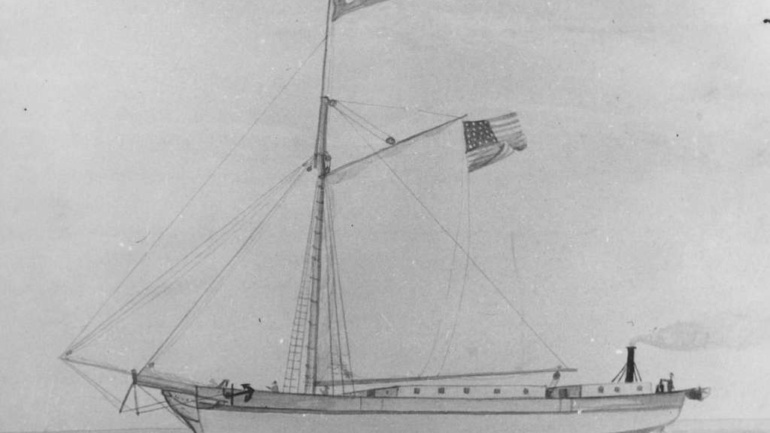
The roots of the Naval Militia in Oswego are buried deeply in the naval traditions of this area. The location of the community at the mouth of the Oswego River, athwart one of the few natural harbors on the southern shore of Lake Ontario, and the significance of the latter as well as the Oswego and Barge canals upon the east west and north south paths of commerce, combined to direct the thoughts and energies of generations of Oswegonians to the water for their livelihood and their recreation. From the days when the first English fresh water naval fleet was built in the Royal dockyard at Oswego in 1755, and the construction in 1809 at Oswego of the first United States battleship upon the Great Lakes, with Lieut. Fenimore Cooper, the later novelist, supervising, there had existed at Oswego a naval tradition.
Hence, it is not surprising to observe that Oswego was an early yachting center, and that the members of its Yacht Club were among the leaders in bringing the Naval Militia to Oswego.
Oswego Unit Authorized
The movement to establish a division of the Naval Militia took shape in the minds of Oswego’s citizenry in 1915; the leadership stemming from members of the Oswego Yacht Club. The plan as it took shape called for the organization of a deck division requiring sixty one members. A year later a temporary committee of organization was effected. It included Henry H. Alexander, now of Pulaski, but then an Oswego newspaperman, and J. M. Gill, Frank T. Watson, Neil T. Hayes, and Elliott W. Mott of Oswego. The committee petitioned Governor Charles S. Whitman for authorization to organize a naval militia unit, and proceeded to enroll a tentative list of applicants. Their request was quickly granted by the Governor, who signed the coveted authorization on October 6. 1916, the official birthday of the Naval Militia in Oswego. The governor’s signature created the 9th Division, Third Battalion of the Naval Militia of New York State, and named Henry H Alexander, who had been telegraph editor of the “Oswego Daily Times” as temporary commander.
The State Naval Militia helped to give the local division a flying start by dispatching the gunboat, “Isla de Luzon”, which had been captured from Spain in the Battle of Manila Bay, from Rochester to Oswego to assist in the recruiting. At the end of the day, nineteen had qualified, and within a month the quota of forty five was reached. Thus on November 15, 1916, the division was mustered into the state service by Captain E. N. Walbridge and staff.
Organization Was Timely
The organization of the division was timely. War clouds darkened the horizon, and our relations with Germany had reached the breaking point. A renewal of her submarine offensive would inevitably plunge the Nation into the maelstrom. Hence the completion of the organization, the procurement of supplies, and the whipping of the division into shape, were carried out at a feverish pace. The division was assigned quarters in the New York State Armory on West First street with the approval of Torrey A Ball, Captain of Company D, Third Regiment of the National Guard of New York, and drills were conducted on Tuesday nights. Chief Yeoman Hubert G. Webb reported to organize the administration.
Recruit To War Strength
As the crisis deepened the Armory was placed under guard by details from the National Guard and the Naval Militia, and on February 3, 1917, the division commander was instructed to recruit up to full war strength of 80 men, and to go beyond this in anticipation of modified orders to permit it. Meanwhile, uniforms and other equipment began to arrive.
Upon the delivery of President Wilson’s war message on April 2, the division awaited the call to duty, to be announced through arrangements with the mayor by the ringing of the City Hall bell. The men had little time to close out their responsibilities to their jobs and their families. Four days later on Friday, April 6, Good Friday, on the day war was officially declared, orders to muster the division arrived in Oswego by telegraph, and at 9 p. m. that night the bell in the City Hall tower rang out the tidings that the nation was at war.
Off To War
The Naval Militiamen reported at the Armory for muster, shifted into uniforms and then returned to their homes. Their departure the following afternoon by rail over the New York Central Railroad for New York City was the occasion for Oswego’s first major demonstration in World War I. In the words of the “Palladium”: “Amid cheers and tears, Lieut. H. H. Alexander, commanding, the Ninth Division of New York Naval Militia got away Saturday afternoon, having the distinction of being the first military unit of the city to leave since President Wilson approved the resolution of Congress declaring that a state of war exists with Germany.
As they came down the Armory steps from the main entrance and swung into First street, headed by the Masonic band, they were greeted by an outburst of applause from the three or four thousand people who lined the sidewalks. The crowd that followed quickly surrounded the train and cheered and cheered and cheered as the boys piled into the cars.” (April 9).
The Muster Roll
The Muster Roll of Naval Militia, State of New York, City of Oswego, Third Battalion, Ninth Division, April 6, 1917, as it left for active duty in the first war with Germany follows*:
Henry H. Alexander, Lieut, (jg); Frank T. Watson, Ensign; Elliott W Mott, Ensign; Thomas L. McKay, Ch. M. A. A. (master of arms); Grover C Elder, Lieutenant (jg), Medical Corps; Hubert G. Webb, Ch. Yeo.; Harold L. Newstead, G. M. 1C; Edward J Condley, Cox.; John L. Fitzgerald, Cox.; Robert J. Potter, Cox.; Alston B. Voorhess, Cox.; Howard C. Flewellyn, Q. M. 3C; Allen P. Snody, Q. M CC; Neil T. Hayes, Yeo. 3C; Ross E. Brown, Sea. 1C; Edwin B Doolittle, Sea. 1C; Herbert K. Fox, Sea. 1C; Charles A. Gill, Sea. 1C; John A. Lester, Sea. 1C; t mes K. McCrudden, Sea. 1C; Francis M. Ready, Sea. 1C; Robert R. Snody, Sea. 1C; Claude T. Ball, Sea. 2C; John F. Bartlett, Sea. 2C; Joseph M. Bisonette, Sea. 2C; James P. Cullinan, Sea. 2C; Earle H. France, Sea. 2C, William H. Hallihan, Sea. 2C; Theodore E. Harding, Sea. 2C; David M. Henderson, Sea. 2C; Edward S. Kelly, Sea. 2C; Ed ward T. Kelly, Sea. 2C; William F. Kerwin, Sea. 2C; Emmett M. King, Sea. 2C; Neil E. Lloyd. Sea. 2C; Robert E. Long, Sea. 2C; Floyd E. Lothridge, Sea. 2C; Chauncey McDonald, Sea. 2C; James C. Mack, Sea. 2C; Alfred E. Maier, Sea. 2C; Sydney R. Mason, Sea. 2C; Charles C. I’eade, Sea. 2C; John P. Moran. Sea. 2C; Verne P. Murdock, Sea. 2C; James H. Mylott, Sea. 2C; William F. O’Donnell, Sea. 2C; George L. Patterson, Sea. 2C; Percy C. Payne, Sea. 2C; Levi D. Pease, Sea. 2C; Thomas J. Reed, Sea. 2C; Jarvis P. Robertson, Sea. 2C; Thomas N. Savas, Sea. 2C; Augustus H. Smith, Jr., Sea. 2C; James P. Sheridan, Sea. 2C; J. Kent Stewart, Sea. 2C; Harry L. Van Dusen, Sea. 2C; Edward B. Wafter, Sea. 2C; Louis B. Ward, Sea. 2C; Roscoe C. Wart, Sea. 2C; Leo J. Heagerty, HA 2C; Jerome J. Eustace, Ap. Sea.; Francis P. Farrell, Jr., Ap. Sea.; Cornelius P. Holleran, Ap. Sea.; Harry D. Hunter, Ap. Sea.; Charles H. Kerwin, Ap. Sea.; Joseph F. McConkey, Ap. Sea.; Robert F. Meade, Ap. Sea ; Joseph Olsiewski, Ap. Sea.; Clarence W. Robarge, Ap. Sea.; Edward J. Snyder, Ap. Sea.; Lawrence J. Wilbur, Ap. Sea.
*Neil T. Hayes has a picture of the division taken at the “Granite State.” He also has the original of this muster.
Kit Bags Presented
At the final muster and inspection just prior to the departure of the train each man was presented with an overnight kit and “ditty” bag, the courtesy of the late Robert A. Downey and the late Frederick B. Shepard, each a prominent business man of Oswego.
At 5:40 p. m. the train pulled out for Syracuse. After having supper at the Hotel Winchester in that city their coaches were coupled to a military train carrying the naval organizations of Dunkirk, Buffalo, and Rochester, and sped eastward. At Utica the cars carrying the Watertown division were attached to the now elongated train. The excitement of the day was not conducive to sleep, but some got a few winks, despite the questionable “comforts” afforded by the “tourist sleepers.”
Oswego Unit Split Up
On its arrival in New York City early Easter morning, the train was shunted down a spur line to the foot of West 96th street, where the U. S. S. “Granite State” was docked. This vessel, the old “New Hampshire”, once a battleship but now converted into a training ship, was a floating workshop, where the men were prepared for their respective duties.There the Oswego boys were joined by the Yonkers division, and within a short time staunch and lasting friendships were formed. A visitor, J. P. Robertson, secretary of the Chamber of Commerce, observed (in the “Palladium” of April 24: “It has been a rich treat to see so many friends from the home town, all of whom I think have received a royal welcome, and in addition to the personal visits, kind and thoughtful favors from Deep Rock (a mineral water bottled in Oswego), Long’s Chocolate Works and the Diamond Match Company have been deeply appreciated. Candy never tasted quite as good, after which Deep Rock, nature’s best, was, of course essential. Then a ‘light’ for the smokes. All of the courtesies help to take the “1”out of Sherman’s definition. Everyone is well because everyone is well cared for. No indisposition is too trivial for the attention of Dr. Elder.”
During the weeks which followed drafts from the Oswego division were dispatched to their various assignments afloat. Some found themselves aboard the U. S. S. “Charleston”, a cruiser, others reported to the U. S. S. “Atlantic II”, a converted yacht, the U. S. S. “Amphitrite”, a rather ancient monitor, the U. S. S. “President Lincoln”, a transport which was later sunk but with no Oswego casualties, the U. S. S. “Mercury”, and others. Oswego men were thus widely dispersed throughout the fleet where they contributed their talents to the early completion of the war.
Reactivated In 1920
After the Armistice was signed on November 11, 1918, Oswego’s sailors gradually returned to their homes, prepared to pick up the threads of their local organization. The division was reactivated in 1920 with Lieutenant H. H. Alexander again in command. He was succeeded by Lt. (jg) Eliot W Mott in 1922, and he, in turn, was followed by Lieutenant J. M. Gill, who headed the organization designated in 1929 as the 15th Division, some 17 years, until 1940 when Lieut. Gill was called into the Federal service in World War II from which he emerged in 1945 with the rank of commodore.
During this era between the two World Wars the division drilled on Tuesday evenings, and supplemented this training with annual cruises with the fleet on the Great Lakes or upon salt water. In 1920 the division cruised on the U. S. S. “Pruitt” and the U. S. S. “Noah”. A year later they sailed to Bermuda aboard the U. S. S. “Illinois”. It proved to be the last cruise for this ship which was subsequently reconverted to become the U. S. S. “Prairie State”, famous as a training ship in World War II. In 1923 and 1924 the division cruised upon the Lakes in the U. S. S. “Sturgeon Bay”, reaching points as far west as Chicago and Duluth. Oswego personnel also participated in numerous small arms contests during the 1920’s and 1930s, winning several prizes in statewide competition. In 1925 they gained the distinction of taking the secondary battery prize. Noteworthy, also, was the record of the division in the annual Federal inspections. Between the two wars the Oswego unit never dropped below 15th, and on one occasion it ranked first in the nation.
Training Between Wars
The training of the division was rounded out by a program of boating and related activities in the harbor and upon neighboring waters. In 1921 the organization had at its disposal two cutters, two whaleboats and a steamer, and these in turn were supplemented a short time later by the receipt of the floating equipment from Onondaga Lake, after the failure of the Syracuse organization which had its station there. An incident which should not be overlooked involved the conversion of a 40 foot motor launch into a motor sailer as designed by Lieut. Commander Gill. This vessel proved to have so much utility, that all 40 and 50 foot motor launches in the reserve division were similarly reconverted.
In 1921 the floating equipment of the Oswego unit was housed on the lower floor of the building on the lower bridge now known as the McKay Block. In 1924 the division took over the building on the West river bank at the foot of Schuyler street, the old stone structure erected as a warehouse for Walton & Willet, forwarders, nearly 100 years earlier, now occupied by the Cahill Fishery. Franklin D. Roosevelt, early in his first term as governor of New York, inspected this property and took a ride on a sub chaser which came down from Rochester for the occasion. The feature of the formalities was the firing of the traditional 19 gun salute for the governor.
Occupy New Quarters
In 1935 the division moved its floating gear to the site of its new training center recently opened on Lake street in the West Harbor, where it occupied the property of the Oswego Yacht Club, which had been taken over by Oswego County and deeded to the State of New York for the use of the Naval Militia. This property, improved by the construction of new docks, a feature of the W. P. A. program in this area, provided the Naval Militia with permanent housing and docking for its floating equipment, and facilitated the erection of its new home on the same site 15 years later.
World War II Service
Upon the outbreak of World War II in Europe in 1939 the Naval Militia again intensified its training program. In May, 1940, Commander Gill went into active duty as officer in charge of naval officer procurement with headquarters at Buffalo, and he was succeeded in command of the Oswego unit by Lieut, (jg) Eugene E. Cragg. In February, 1941, the first draft of men from the division, numbering 26 men, left for active duty. On May 15, almost seven months prior to the Japanese attack on Pearl Harbor, the entire division was mobilized. This time they were transported to the Naval Training Station at Newport, Rhode Island, for their final training. The muster list of those going into active duty between November, 1940, and May 15, 1941, follows:
New York Naval Militia: Muster list of those entering active duty in 1941 for service in World War II:
E. E. Cragg, L t (jg); J. A. Ward, Ens.; J. M. Gill, Jr., Ens.; W. E. McCormick, Ens.; John M. Gill, Commander; C. L. Lynn, Lt. S. C.
Those leaving on May 15, 1941: C. P. Holler an. C. B. M.; G. W. Woods, C. W. T.; J. J. Knosp, C. C. M.; L. E. Lower, B. M. lc ; W. L. Richardson, Q. M. lc; J. M. Fitzsimmons, M. M. lc ; C. A. Ricchi, M. M. lc : J. G. Manale, M. M. lc; W. F. Brown, W. T. lc; A. D. Garlock, W. T. lc; U. J LeBlanc, E. M. lc ; R. P. Spang, B. M. 2c; C. G Crisafulli, G. M. 2c; S. T. Herman, W. T. 2c; M M. Beckwith, Bmkr 2c; M. Canale, S. M. 3c; F. W. Rookey, PhM. 3c; V. A. Gadwau, S. C. 3c; H. J. McManus, F lc ; R. P. Schneider, F lc ; C. J. Whalen, F lc ; W. Brewer, S lc; O. A. Clark, S lc ; J. C. Crisafulli, S 2c; H. A. Broadwell, S 2c; J. Butler, S 2c; P. B. Crisafulli, S 2c; F. A. Dehm, S 2c; R. J. Demming, S 2c; G. R. Diehl, S 2c; A. H. Dolan, S 2c; J. C. Dore, S 2c; D. G. Dutcher, S 2c; H. C. Earhart, S lc; G. R. Ferris, F 3c; S. A. Gange, S 2c; J. O. Garrett, F 3c; H. J. Gillen, S 2c; H H. Goodale, F 3c; C. R. Haggerty, F 3c; J. A. Hallinan, S 2c; H. B. Hart, S 2c; F. C. Hen ning, S 2c; J. R. Joy, F 3c; H. J. Knopp, S 2c; J. C Kosbob, S 2c; J. K. Mandirano, S 2c; G. B. Marturano, S 2c; J. J. Matott, S 2c; A. A. McCaffrey, S 2c; Q. E. Mosher, S 2c; E. H. Neild, F 3c; B. L. Nixon, F 2c; J. J. Ottman, F 3c; R. D. Owens, S 2c; J. D. Plunket, S 2c; G. A. Rookey, F lc ; R. E. Roy, F 3c; H. S. Shaver, S 2c; B. D. Verwys, S 2c; M. Kidd, A. S.; C. H. Smith, A. S.; J. Masuicca, A. S.
Those leaving between Nov. 1940 and May 15, 1941: R. A. Fox, S lc; C. J. Crisafulli, Yeo 2c; C. W. Dawson, Cox; G. A. Beauchene, S 2c; R. Borremann, S 2c; R. W. Burke, S 2c; F. H. Czirr, S lc; R. O. Czirr, S lc; F. F. Fultz, S lc ; L. D. Garlock, S 2c; E. H. Grulich, S 2c; L. J. Har rington, S 2c; R. J. Kirshner, S 2c; W. G. Koch, S 2c; R. A. Mas uicca, S 2c; E. J. Parker, S 2a, L. Pelkey, S 2c; J. Pilloto, S 2c; J. W. Signorile, S 2c; C H. Thomas, S 2c; E. D. Timon, S 2c; G. F. Truell, S 2c; R. H. Wallace, S 2c; C P. Wright, S lc; J. Gosek, S lc ; J. P. Smith, S lc.
Included in this muster were three members of the division who had also entered the First World War as members of the unit in 1917: Commander Gill, Lieut. Neil T. Hayes, and Cornelius P. Holleran, chief bos’ns mate.
Service On the “Chemung”
From this time onward members of the division moved on to assume duties in the Atlantic and Pacific Theatres. At the outset the majority were transferred from Newport, R. I., to the Brooklyn Navy Yard, where they helped commission on July 3, 1941, and subsequently fit out and “shake down,” the U. S. S. “Chemung”, a U. S Navy Tanker. Since more Oswego men served on this vessel early in the war than on any other, it would seem to be appropriate to follow it briefly. The “Chemung”, a vast, floating filling station, was on duty in the Atlantic along the East Coast and between New Foundland, Iceland and the British Isles. It also entered the Mediterranean to support the invasions of North Africa and Sicily. Late in the war it moved into the Pacific. In fact it was the first and only U. S. naval vessel to make a complete tour around the world after the “Great White Fleet” of 1907. A typical itinerary through a period of several years would include the following ports: (An atlas is recommended at this point): Brooklyn Navy Yard; Norfolk, Va.; Bermuda; Norfolk; Argentia, New Foundland; Portland, Maine; Norfolk; New York; Halifax; Reykjavik, Iceland; New York; Norfolk; Bay town, Texas; Norfolk; Bay town, Texas; Nor folk Argentia; Rejkjavik; Argentia; Norfolk; Beaumont, Texas; Portland, Maine; the Mediterranean, Casa Blanca; Norfolk; Port Arthur, Texas; New York; the Mediterranean; Oran, North Africa; New York; Swansea, Wales; Norfolk; Courock, Scot land; Bangor, North Ireland and Norfolk.
“Chemung” Has Narrow Escape
Moving slowly because of her breadth abeam, in seas infested with submarines, equipped with depth bombs to explode the latter, but lacking sound apparatus to locate them; it was a life of extremes, including, the monotony of endless days afloat, the physical exhaustion of long and tedious hours of fueling at sea, the excitement of an unexpected emergency call to general quarters, and liberty or shore leave in foreign ports. The “Chemung” on one memorable occasion collided with the U. S. S. “Ingraham”, a destroyer, in the mist off Halifax, Nova Scotia. The latter ship sank in a few minutes with few survivors. The bow of the “Chemung” was dished in and the ship set afire. But the fire was extinguished, the hull shored up, the holes closed, and she proceeded back to port with the U. S. S. “Buck” under tow, the latter a victim of a second collision in the waters close by.
Four Killed In World War II
The war inevitably produced casualties among the personnel of the Naval Militia. Included among those who sacrificed their lives were the following members of the Oswego unit:
Ulric LeBlanc, electrician’s mate first class, aboard the U. S. S. “Edward Rutledge”, torpedoed off Casa Blanca during the African invasion, November, 1942
Charles Crisafulli, gunner’s mate second class, aboard the U. S. S. “Truxton”, a destroyer, ran aground during a storm off New Foundland, February, 1942.
Robert Kosbob, seaman, aboard the U. S. S. “Sims”, a destroyer; torpedoed during a Japanese air attack in the South Pacific.
Ensign James M. Belden of Syracuse; aboard the U. S. S “Reuben James”; torpedoed in the North Atlantic on October 30, 1941, the first warship of the U. S. Navy to be sunk in the war.
William Brewer, Ensign, killed in an automobile accident in Hongkong, China, March 7, 1946, after serving on the U. S. S. Chemung, and later, aboard a cargo ship in the Pacific.
Third Reactivation
After the surrender of Japan, members of the Division began to return to their homes, and thereby set the stage for another milestone in the history of the Naval Militia in Oswego, that is, the reactivation of the organization for a third time. The reorganization was consummated on October 7, 1946, with Lieut. Kent M. Northrop in command. In January 1947, Northrop was succeeded by Lieut. M. L Robinson, who was named as commander of the organized surface division 386 of the United States Naval Reserve and of the fifteenth division of the New York Naval Militia.
Upon Robinson’s retirement in March, 1949, the command was transferred to Lieut. Samuel G. Castaldo, who headed the division until November 1950 when he was called into active duty. Lieut. Robert D. Helsby now commands the outfit. Meanwhile, supervision of the Naval Reserve activities in the area was entrusted to an inspector instructor, a position filled until recently by Commander Paul J. Williams, assisted by Lieut. E. O. Dahl.
Present Enrollment Exceeds 6,000
The New York State Naval Militia, when reactivated after World War II was commanded by Commodore John M. Gill of Oswego. The organization included brigades in New York City and Brooklyn; battalions at Tomkinsville, Staten Island; Buffalo; Rochester; and Whitestone on Long Island; divisions at Dunkirk; Watertown; Oswego; New Rochelle; and Yonkers. The present personnel (December 1, 1950) of these units totals about 290 officers and 5,900 enlisted men. The New York Naval Militia also includes companies of Marines on the U. S. S, “Prairie State”, New York City; Rochester; and New Rochelle, and a headquarters battalion at Brooklyn. These units had a strength of 900 prior to their departure for service in the United Nations War in Korea.
During the past two years United States Naval vessels have been a familiar sight along the water front of Oswego, where they have been docked between cruises on the Lakes, and for refitting during the winter months Some of these ships saw active service in World War II as mine sweepers.
The personnel of the local division, meanwhile, has reached its full strength of 200 men. Recruits, many of them sons of the earlier members, keep filling the gaps. Worthy of mention in this connection is the retirement last month of Lieut. Neil T. Hayes, a charter member with service in both World Wars after 34 years activity. Simultaneously his son, Neil T. Hayes, Jr., was commissioned as an Ensign in the United States Naval Reserve.
New Training Center Dedicated
The new Armory Training Center on Lake street, dedicated on September 16, 1950, opens a new chapter in the history of the Naval Militia in Oswego It is more than a means of training naval personnel “to meet the needs exacted by a highly technical and mechanized service which admits no haphazard preparation for fulfillment of the mission of the Navy, in peace or war.” It is in reality a youth center where many of this community may prepare not only for tasks related to national defense, but also for the broader responsibilities of citizenship. A rich tradition, combined with a current history marked by notable achievement, forecasts bright prospects for the Naval Militia in Oswego.