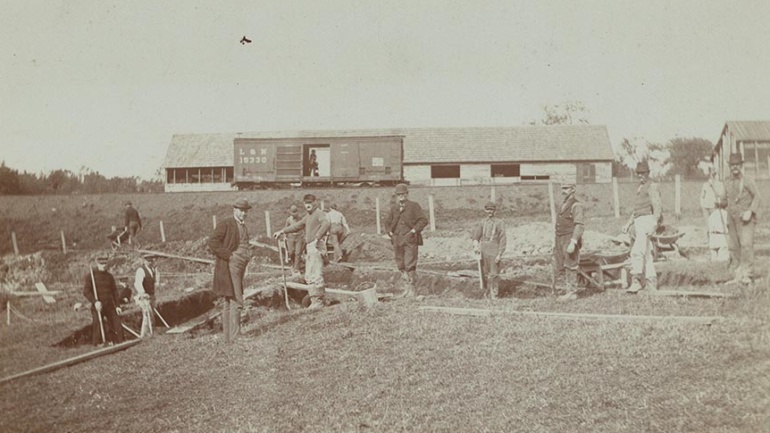
This essay was originally published in the 1939 OCHS Yearbook. Please note that this essay was published over 80 years ago. While still useful for general education, language may be outdated and at times offensive. The Oswego County Historical Society does not stand by the language used in this essay. All photos were added in 2026 when this article was uploaded to the web. To view the original document, please visit NYHeritage.org
Paper Read Before Oswego Historical Society by John M. Gill April 20, 1939
Wide and swiftly the river flowed into the lake, between coves formed on either side by action of waves and current through the centuries after recession of glacial ice. On the right hand, a towering bluff; to the left, level lands sloping upward inshore, and bluffs and lowlands alternating to the west. To the north, expanse of tumbling waters. Everywhere, growing down to high water mark, the primeval forest.
This was Oswego, “Rapid water,” in Iroquois and guardianship of the mouth of this river and of the lands about it was the sacred trust of the Seneca Nation, “Keepers of the western door,” of the Five Nations. The lake was Ontario “Pret ty lake,” in Iroquois, theirs to control from the time the Long House came into being in the Council fires of the clans at Onondaga, and the might of whose Confederation had spread from Virginia to the lakes of the north, and westward to the plains beyond the Ohio.
Soon, with the 17th century on its way. This primitive scene was to be changed. European powers, warring as they had been since civilization’s dawn for commerce and lands, were looking to new continents as arenas for renewed conflict. Great Britain and France looked to America for more lands and increasing trade.
Jesuits Preceded Military
Vanguard of French advancement in the new world was not in its military heroes, but in the even more militant French Jesuit Missionaries, seeking souls to be saved. So it was, perhaps, the first white man to enter the waters of this river, and to be paddled down to its mouth by his Indian guides, was Father Simon Le Moine who, in August, 1654, at Onondaga, had told his Five Nations hearers: “Peace walks along with me; I drive war afar off among the distant nations, and Joy accompanies me.”
The promise of peace was not long to endure, and the pledge of joy to come was but fleeting, in events that soon were to follow.
In his journal, on August 19, he wrote : “We proceed on our journey on the same river, which is of fine width and deep throughout, except some shoals where we must get into the water and draw the canoe lest the rocks break it.”
On August 20, he noted: “We arrive at the Great Lake, Ontario, called the Lake of the Iroquois.”
So Father Le Moine passed on his way, out into Lake Ontario, and eastward to the sea, but his visit, brief as it was in the two days during which he was storm bound at Oswego, nevertheless was to be basis for claim to the river and the lands he traversed, by the country that had sent him forth to America.
This early claim by France to Oswego was further substantiated by Comte de Frontenac, as the century drew to a close, and, as in July, 1696, he left his heavy baggage at the mouth of the river and proceeded with his forces inland, upstream, to teach the Five Nations not lessons of Peace and Joy, but of War and Bloodshed. Comte de Frontenac returned from the hinterland by the same route to Oswego, but he left behind him hatred for things French among the Five Nations, henceforth to be allies of Great Britain, and to hasten the time when Oswego was, for many years to come, to be a battleground of nations.
Great Britain and France were at peace, ostensibly, under provisions of the Treaty of Utrecht, which was vague as most treaties must be, when those who draft them are supremely ignorant of the scope they pretend to cover.
Both nations were exploiting the Indians in the fur trade, only commerce in new lands that had value in Europe. The Treaty of Utrecht failed to define boundaries for North American colonies, but home governments in Europe, land covetous and tradehungry, instructed their colonial governments to assert and make good all possible claims. When the fur trade was actively started in Oswego is indefinite. Dutch traders from the Hudson were at the mouth of the river in 1720, and in 1721 Governor Burnet wrote to the Crown from New York. “This, my Lords, is the beginning of a great trade that may be maintained with all the Indians upon the Lakes, and the cheapness of all our goods, except powder, above the French, by degrees will draw all that trade to us.”
First Building In 1722
In 1722, a trader from the Hudson built a trading house at Oswego, subject of a report by French authorities to Paris in that year, and December 8, 1724, Marquis de Vaudrueil, Governor General of Canada, advised that the English and Dutch had a settlement at the mouth of the river Chouaguen, and in his opinion “should the English fortify Chouaguen, there is difficulty in preserving Niagara, and, in losing Niagara, the colony is lost and, at the same time, all of the trade of the Upper Country Indians, who go more willingly to the English, since they obtain goods there much cheaper and get as much brandy as they like.”
Sieur de Longucuil, aide to the Governor of Canada, complained in 1725, while in a mission to the Five Nations, at Onondaga, to gain consent for erection of a French fort at Niagara, that he was detained on the Oswego River, twelve miles from its mouth, by a party of 300 English traders who were bound for Oswego and compelled to show his passports. The French, under the Indian consent, fortified Niagara that year and built two sailing ships there.
Fort Oswego Built In 1727
Fort Oswego, on the west bank of the Oswego River at its mouth, was not built until 1727, its completion reported to the Board of Trade August 24, by Governor Burnet who, describing the rapids of the St. Lawrence River in his report, gave his opinion no seige guns could be brought westward by the French, and that the fort at Oswego was sufficiently strong against small arms or even the patereros, guns which one man may carry in his arms, with which the French had armed Fort Frontenac. With the party of 300 traders and workmen to Oswego came a company of provincial troops numbering 60 men and three officers, its first garrison. Four six pounder guns were later in the year brought from New York.
So trumpets and drums came to Oswego, never to cease their sounding, except for brief interludes, for more than two centuries to follow.
In the years that passed, Oswego became the greatest fur trade post upon the continent. To that post, where of all in control of the British it was the only one where rum could be sold to Indians, came Indians from the upper lakes, spending the entire summer in their long canoe voyages from Superior and Huron forests, bearing with them furs from points as far west as the unknown Rocky Mountains and the great western plains. More than 100 traders’ houses were built at Oswego on both sides of the river, and it was a common sight to see 150 or more canoes drawn up on the shores, while Indians from far and near traded and bartered furs for trinkets and blankets and bracelets and powder and ball, but more for rum.
For a quarter century, only rumors of impending strife disturbed the garrison at Oswego, which meanwhile had been permitted to drop in strength to one officer and 30 men, in spite of pleas of Sir William Johnson and others, that the post be strengthened. From 1750 on there were border incursions and raids on both sides, and in 1754 the fur traders, except a few of the more brave or less timid, left Oswego when it appeared war was imminent. War actually was not declared until May 17, 1756, but the two previous years had witnessed an undeclared warfare on the northern frontier.
In 1754 the garrison at Oswego was increased to 100 men, with Captain Edward King in command. He was an alert and vigilant officer and his reports indicated he kept constantly in touch, as circumstances permitted, with the movements of the French at Niagara and Frontenac.
If Great Britain was preparing for war, the same was true of the French and of the two forces in America, in the northern sphere of activity to come, the French were far more enterprising and far more alive to the objectives most desired and the means of their attainment.
Fontenoy Prelude
Prior to the Seven Years’ War, or the French and Indian War as its engagements in America were termed, the accolade of experience in battle was given to those troops that had met on May 11, 1745, at Fontenoy in Belgium, in the war of the Austrian succession.
Because that particular battle had connection with the war in America, as well as for its strategic and tactical repute from the view point of a study of military science, its main features may be recalled. British troops and Hanoverians were allied against the French, then besieging Tournai, with relief of that city the British objective. The Duke of Cumberland commanded the allies, and Marshal Saxe, the French Fontenoy was the highlight of King Louis XV’s military career. He and the Dauphin and the dukes and nobility of Versailles were present, with ladies of the court, to witness the spectacle. His Majesty was there also to lend authority to Marshal Saxe, who, ill with dropsy, directed French troops from a sort of phaeton or light carriage in which he was driven about the battlefield. In the approved continental method of engaging the enemy, the armies deployed, face to face.
Lord Charles Hay, a British officer, stepped out of the British ranks and, waving a flask, shouted across the intervening space to where the French troops stood; he hoped the French would stay and drink with him and not run as at Dittigen. A French officer, polite but not understanding English too well, stepped from his command and, doffing his hat in salute, replied that the French could never fire first and implored the British to have that honor. The British did, and the carnage was the greatest in history, as indeed was the toll of dead and maimed on both sides for the numbers engaged. From seven o’clock until midafter noon the battle raged. The British advanced to the height of land where the French guard laid dead in piles and, forming the celebrated hollow square, blazed death on all sides against French efforts to dislodge them. The court prepared to flee. Marshal Saxe mounted a horse and, after the French artillery, the French cavalry and every effort by French troops had failed, rode to a side of the battlefield, where two brigades, ordered not to engage, had stood under arms since daybreak.
They too were British, but exiles from Scotland and Ireland, sympathizers from the rebellion in the north and haters of the German succession to the throne of England. Two regiments were Scottish; two were Irish. Marshal Saxe gave the command and the Irish and Scottish brigades moved to the attack. In eight minutes the British square was broken, and Fontenoy was won for France but not by French arms.
A war serves the purpose, if the interval be not too long, for the experience of leadership in the next war to come. The profession of arms can only be made expert by its practice. Fontenoy was the cradle for the Seven Years’ War and its lessons were not forgotten.
Traditional enemies who had met at Fontenoy were again to resort to arms to settle longstanding differences on the American frontier.
Bounties Of War
There was no misunderstanding on the part of American colonists as to what war with the French would mean. The French held Crown Point and Ticonderoga and raids to the Mohawk and the Hudson not only were possible but, based on experience, extremely probable. More than 4000 residents of exposed frontiers in New York and New England left their homes for safer havens, when the undeclared warfare started. There was reluctance on the part of colonials to enlist in sufficient numbers in the British and provincial troops being raised. As in England, it became necessary to proclaim bounties, but in America the bounties were in land grants, not in money, and the bounties in effect later were to be basis for the land grants of the Revolutionary War.
A colonel would receive 1,000 acres of land in New York, New Hampshire or Nova Scotia; a lieutenant colonel or major, 750 acres, a captain, 500; a lieutenant or ensign, 400, and a private soldier, 200 acres, and these grants would pass to widows or children of any killed during the war.
There were other bounties not so openly cited. They were paid on both sides in the war that was to come in America, and were to be responsible for massacres and for cruelties that previously had never been brought into warfare between civilized nations.
The colonial governments agreed to pay: “For the person of a male prisoner, Indian, above twelve years of age, the sum of $150; for a scalp of a male Indian more than twelve years of age, $130; for the scalp of a female Indian more than twelve years of age, $50; for the rescue of each English prisoner taken by the Indians, unharmed, $350; for the scalp of an Indian Chief, $350.” A notation on the posting of this proclamation was piously worded: “It is thus necessity obliges Christians to descend to cruel measures.”
Fear of death at the hands of Indians, or capture and worse than death to follow, not alone held back American recruiting. It was to handicap effectiveness of British troops for three years; to delay campaigns; to cause men brave by European war standards to hesitate trusting themselves into the dark forests and mountains, fearful lest the abzoriginal warwhoop would be their first warning of death from ambush.
Fort Oswego was the lookout post for England on Lake Ontario. Its importance was recognized in June, 1754, when the Council of Colonial Commissioners met in Albany and adopted a resolution, offered by Thomas Pownall, Deputy Governor of New Jersey, that Oswego be made a naval base, and the reaction was sent forthwith to England and approved by the ministry. Plans for suitable ships were prepared by the Admiralty and before he departed for America, Major General Edward Braddock, early in 1755, was instructed to strengthen the fortifications at Oswego; to increase its garrison, and to insure command of Lake Ontario by construction and maintenance of ships upon that lake.
Plans For Oswego
A Council of Colonial Governors was held April 14, 1755, in Alexandria, Va. The Council and General Braddock waited three weeks for Governor Shirley to appear. The campaign was mapped, with Braddock to subdue Fort Duquesne, on the Monongahela; Major General William Johnson to take Crown Point and Ticonderoga; and Major General William Shirley to take Fort Niagara. To General Shirley fell the duty of carrying out the Oswego program as incidental to his mission at Niagara. The conference was attended by Commodore Augustus Keppel, Royal Navy, commanding the British Fleet in North American waters. He agreed to furnish the plans for the ships to be built at Oswego and the officers to sail them.
General Braddock had been in command of a battalion of the Coldstream Guards at Fontenoy and an aid to the Duke of Cumberland. He informed the Council the capture of Fort Duquesne would be a matter of “two or three days, at most, and thence I shall march on to Niagara.” Benjamin Franklin, who was his quartermaster general in a civilian capacity, doubted the latter part of the statement. Braddock had the 35th and the 42d Regiments in his force, arrived in April from Ireland. Captain Horatio Gates commanded the New York troops. He was training for Saratoga to come, 22 years later, Braddock was ambushed July 9 1755, Lieut. Col. Thomas Gage, later commandant at Fort Ontario, of Lexington and Concord and Bunker Hill, commanding the advance guard, waylaid by the French and Indians. The tactics of Fontenoy were not those of Duquesne. Brad dock was shot by one of his own men, died July 15, and was buried at night, Col. George Washington reading the burial service, and his grave unmarked that it might not be the lot of a French Indian to claim a British General’s scalp. Duquesne had proven more than a twoday task.
Meanwhile, General Shirley undertook his mission. But delays were many in its accomplishment, delays that were later to bring his recall to England and invited severe criticism in America.
A force of 320 shipwrights, ship smiths and artificers were recruited in Philadelphia. Boston and New York to build the ships at Oswego. The first workman reached Oswego on May 27; the shipwrights from Boston ten days later. When the men had been assembled and had started felling trees for timber, it was found only one bellows had been included in the equipment and only one forge could be worked. Difficulties may be comprehended from the fact every tool, every bit of ironwork; every block and piece of rigging and equipment had to be transported to Oswego and much of the gear brought from England.
The First Ship
On June 28, the first English man-of-war built on the Great Lakes was launched from ways on what was later known as the Upper Island, close under the walls of Fort Ontario, but then the spit enclosing the west cove. This ship was His Majesty’s Ship “Oswego,” 40 feet on the keel, schooner rigged, with 12 swivel guns as armament. She was small, by modern standards, but the Royal George, launched February 18, in England that year and Britain’s largest line of battleship, was but 144 ft. on the keel and had been building ten years. Small as she was, Commodore William Bradley, R. N., displayed his broad pennant and, taking command, the “Oswego” hoisted her topsails and sailed from the river into the lake while a four pounder gun boomed a salute from the fort and drums sounded.
Other ships followed, larger in size and of heavier armament. They were the “Ontario,” the “Victory” and the “George,” one a snow, one a brigantine and another schooner, and two hundred batteaux and whaleboats were assembled, either built at Oswego or brought from Schenectady to convey to Niagara. The river batteaux were unsuited for lake passages, for which the French batteaux were well adapted.
Col. Peter Schuyler’s advance detachment of New Jersey provincials reached Oswego July 20, and he with the remainder and the artillery some days later. General Shirley arrived August 17, with the two regular regiments, except for the artillery which Col. Mercer brought up August 31. At a Council of War, Sept. 18, decision was reached to move against Niagara and provisions and supplies were loaded on the vessels. Sept. 26, the troops were ordered to embark, but a heavy gale brought necessity for disembarking.
At a Council of War the day following, decision was reached to cancel the Niagara expedition because of lateness of the season, and to leave workmen and the garrison to the task of building two other forts, winter quarters, barracks and more ships and barges. General Shirley returned to Albany and disbanded his three companies of New York provincials, and activities against the enemy ceased for the winter months.
In Shirley’s forces was Captain James Barrett, who organized and led the Minutemen “t Lexington and Concord, and in whose house were stored the munitions which the British troops from Boston sought to capture at the outset of the War of the Revolution. William Alexander, afterward Lord Stirling of the Revolutionary Army, was Shirley’s military secretary.
Shirley, on his return to New York, complained to the English Ministry Sir William Johnson, had refused to give him Five Nations Indians to aid his expedition. Sir William, replying to an inquiry, wrote he was certain Shirley would find all the Indians he wanted at Oswego. He did not explain they would be French Indians. The truth of it was that the Five Nations were reluctant to fight at Oswego, holding it treaty ground; and a place for peaceful trading. There was also the fact that hundreds of Indians who had been won over by Abbe Francois Picquet, at La Presentation, were Iroquois and fought with the French at Oswego. There were no Indians in the Oswego garrison in 1756.
The winter was a severe one, of extreme frost. French Indians hai assed workers; rations were short; salt meat brought on black scurvy; fear of Indians kept hunting parties close to the fort.
As spring of 1756 came, the situation at Oswego had been changed. There were three forts; Fort Oswego, enlarged and strengthened by outworks, Fort Ontario built on the east bluff, and Fort George on the rise of ground southwest of Fort Oswego.
Forts At Oswego In 1756
Fort Oswego was built of loosely cemented stone, about 100 feet square, two stories high, with galleries for riflemen and loopholes above and below, embrasures for twelve cannon. Around it, 18 feet from the walls, was a stone wall 10 feet high, loopholed, with towers on the landward corners. Further, on the landward side were trenches built in 1755 and early in 1756, inside of which were wooden barracks, storehouses, a hospital building and other structures.
Fort Ontario was a square, 180 feet on a side, the landward sides broken by angled extensions to make the shape not unlike an irregular star. Smoothed logs, 18 inches in diameter and joined tightly, rose eight or nine feet above the level. Around the inside of the walls were platforms for riflemen and loopholes and embrasures lower down for cannon. Around the structures was a ditch 18 feet wide and eight or ten feet in depth, the excavated earth being used to add to the strength of the ramparts and to slope steeply the ditch approaches Its guns commanded the land ward side and it was built in the middle of the bluff so that guns could not bear effectively on either the lake or river side.
Fort George was merely a palisade of wood 10 feet high, embanked with a surrounding trench never completed. It had no guns and was at best a mere expedient as a fortification. It stood 1800 feet southwest of Fort Oswego, which it dominated from its position on the high ground which sloped from its lakeward side to Fort Oswego. Within musket shot to the south and west was forest, and it was not until the first day of the Battle of Oswego that brush and trees were cleared from its immediate vicinity.
The Garrison consisted of the 50th and 51st Regiment of Foot, which had been at Fontenoy and had been ordered to America in 1754, to become known as Shirley’s, or the 1st American Regiment, and Pepperel’s or the 2nd American Regiment, and Col. Schuyler’s New Jersey Provincial Regiment, with an artillery train plus the seamen and workmen and batteauxmen, all of whom were armed, the batteauxmen with hatchets especially provided.
Colonel Mercer of Pepperel’s Regiment was in command. He had gone on halfpay after Fontenoy and was gazetted to the 2nd American Regiment October 7, 1754, the same date on which Major (later Lieut. Col.) John Littlehales, also a Fontenuy veteran, was gazetted to Shirley’s Regiment, which he commanded at Oswego.
Colonel John Bradstreet, former Lieut. Governor of St. John’s, Newfoundland in 1746, in 1755 had been placed in charge of forwarding stores to Oswego from the Hudson. In 1756 he was appointed Commissary General for British forces in America and continued his direction of supplying the Oswego garrison, a task he accomplished with distinction, as he did other more aggressively military duties later in the war, for which he was promoted to MajorGeneral and made Deputy Quartermaster General of the British Army. With spring, Bradstreet resumed the assemblage of munitions and stores at Oswego.
Batteau Transport
Difficulties of transport in America were recognized in England, where the following description of troops movements to Oswego was published: “The fort at Oswego is reckoned near 300 miles almost due west from Albany, in New York, but the way to it is more convenient as the far greater part of it admits of water carriage, by what they call batteaux, which is a light flatbottomed boat, wide in the middle, and at each end sharppointed, of about 1500 lbs. burden, and is managed by two batteauxmen, with paddles and setting poles, as the rivers are in many places too narrow to admit of oars. From Albany the travelers set out first by land, for the village of Schenectady, which is a land carriage of 16 miles, in a good wagon road. From thence to the Little Falls, in the Mohock (sic) River, at 65 miles distance, the passage is by water carriage up that river, consequently against the stream which in many places is a little rapid, and in some so shallow that the men are, when the water is low, obliged to turn out and draw their batteaux over the rifts with hard labor. At the Little Falls there is a portage, or land carriage, for about a mile, where the ground being marshy will admit of no wheel carriages, and therefore a colony of Germans, settled there, keep sledges on which they draw the loaded batteaux, to the next place of embarkation on the same river. From thence they proceed by water up that river for 60 miles to the carrying place near the head of it, where there is another portage, which is longer or shorter, according to the dryness or wetness of the season, being usually in the summer months, six or eight miles over. Here the batteaux are conveyed in the same manner as at the Little Falls, and at the further end of this portage they launch into a narrow river called Wood Creek, which runs into the Oneyda Lake. Down this river they proceed with a gentle stream to the lake, distant about 40 miles, but though the current be in their favour, the passage is troublesome as the river is shallow and its banks covered by thick woods of large trees which, by falling into it, often obstruct the passage of the batteaux until they are removed or their branches lopped off by the batteaumen. The Oneyda(sic.) Lake stretches from east to west about 30 miles and is passed in calm weather with great pleasure as well as facility. From the eastern end issues the river Onondaga which, after a course of between 20 and 30 miles, unites with the Cayuga or Seneca River, and their united stream runs into Ontario Lake where the Fort Oswego is situated. From Oneyda Lake therefore the batteaux have the current in their favor, and it is pretty rapid, but this renders the passage the more difficult and hazardous, as the river through the whole of its course abounds in rifts and rocks and, about 12 miles on this side of Oswego, there is a fall of 11 feet perpendicular. Here, therefore, there is another portage which does not exceed 40 yards, when the batteaux launch for the last time and proceed with an easy course to Oswego.”
De Vaudreuil, reporting to the Ministry in Paris in 1755, had emphasized the threat of Oswego to French claims for possession of the south shore of Lake Ontario, stating: “From the hour of its foundation, Chouaguen is the rendezvous of the different Indian tribes. It is from Chouaguen proceed all the belts and messages the English scatter among the Far Nations. It was always at Chouaguen that the English held Councils with the Indians, and by means of presents, principally of intoxicating liquors, persuaded them to assassinate the French. In fine, Chouaguen is, consequently, the direct cause of all the troubles that have supervened in the Colony and of the infinitude of expenses these have entailed on the King.”
The reduction of Chouaguen, or Oswego, naturally followed as the first essay of Montcalm when he took French command in the North American theatre of war”.
Influence Of Sea Power
No more striking example of the influence of sea power on history exists than in events leading up to the capture of Oswego. The service of information and security was never more ably demonstrated, and while forces engaged on Lake Ontario might be considered insignificant compared with those otherwise active afloat in the other theatres of the Seven Years’ War, yet if the loss of Oswego was of major importance to the English, so too must sea power of the French be given full weight in enabling French objectives to be attained in the campaign.
The capture of Oswego otherwise demonstrated effectively the desirability of singleness of command. The strategy of Montcalm, his skillful movement and disposition of troops at his command, the measures taken to conceal those movements; and the celerity of accomplishment in disregard of the very handicaps of which the English leadership complained, was in decided contrast to the forces and the delays and long clumsy movement of the English drawnout preparations for any movements that could not but be communicated to the enemy long before possibility of accomplishment.
Louis Joseph de St. Veran, Marquis de Montcalm, Field Marechal of the armies of France , was a soldier by profession rather than by chance or necessity. He too had been at Fontenoy and had distinguished himself at Placenza. When he took command in America, he energized the entire establishment, sparing himself little and his troops not at all.
Plans Of The Campaign
Since 1755 the French had maintained an outpost at Six Town Point at the mouth of the Black River, which they called Naioure Bay, whence were dispatched the scouting parties that maintained contact with English activities at Oswego. This outpost was commanded by Sieur de Villier, who had led the French and Indians in the defeat of Braddock at Fort Duquesne. De Villier was ordered to take his forces and harass English communications along the Oswego River. Sieur de Rigaud de Vaudrueil relieved him at Naioure Bay with Canadian and Indian reinforcements which were to be the vanguard for the Oswego expedition. Major Descombles of the Royal Engineers was ordered to reconnoitre Oswego and plan its siege. Bigot, Intendant of Canada, was entrusted with the same duties Colonel Bradstreet performed for the English, the service of transport and supply.
DeVillier accomplished his mission well. No working party outside of the Oswego fortifications was safe after early April; no batteaux along the river could move without the constant fear by their crews of attack. French and Indian scalping parties, hidden in the forests, cut off stragglers; batteauxmen demanded and had to be paid higher wages for the risks incurred. On April 12, twelve carpenters working 300 yards from Fort Oswego were killed, scalped or taken prisoners; on May 17, two miles up the Oswego River an officer, soldier and Indian were killed in an onset; on June 16, the forts were harassed by musketry, after batteauxmen had been attacked, and six killed, with the New Jersey regiment losing 26 men killed, the regular troops 6, and many others wounded. Transports along the river became more perilous. Bradstreet ordered movements concentrated and as many as 400 whaleboats and batteaux moved in convoy at one time for protection. On July 3, 1756, Bradstreet was attacked at Battle Island, where a fourhour forest battle followed, with his losses 40 killed and 24 wounded. Bradstreet had with him Captain Phillip Schuyler, Captain Marinus Willett and Captain John Butler at the time, all of whom were to serve in a later war with distinction.
Colonel Bradstreet, after the engagement at Battle Island, learned from French prisoners he had taken that Montcalm planned to attack Oswego, and hastening to Schenectady, arriving July 11, left his men and boats there, and the day following reported to Major General James Abercrombie at Albany, urging reinforcements be sent at once. Abercrombie ordered Major General Webb with the 44th Regiment to leave for Oswego, but while the regiment was preparing to depart, the Earl of Loudoun, ordered from England to command the troops in America, arrived and in the argument with Albany and other interests, fearful of attack from Crown Point and Ticonderoga, it was August 12, before Webb and the 44th left. When they reached Wood’s Creek, they met escaped members of the Oswego garrison and Webb halted and had his men cut trees to block the creek and returned to Albany. Had the 44th been dispatched in midJuly, results at Oswego might have been different.
First Naval Engagement
The English fleet then of three ships had been since early June cruising in Lake Ontario in an effort by the officers to learn something of the waters. There were no charts, no sailing directions, no lighthouses or aids to navigation. But there were French men-of-war and on one of these exploratory cruises on June 26 occurred the first engagement, a running fight with H. M. S. “Oswego,” Commodore Bradley, 45 men; H. M. S. “Ontario,” Captain J. Lafory, 45 men, and a smaller schooner, the “Alert,” Lieut. Farmer with 14 men, the English ships endeavoring to reach Oswego, and the French vessels, the “Marquis de Vandreuil” and the “Victoire,” both bark-rigged, with crews of 60 men each to cut them off. The larger English ships made the safety of the forts, but the French captured Farmer and his ship and crew. English cruising was halted effectively and the French remained alert to keep their enemies afloat close to Oswego, stalemating any effort through the fleet to secure information of movements by French forces on the lake. Two other ships, snow and brigantine rigged, respectively, were later launched. Their cost was 22,000 pounds Sterling, an account long disputed between the colonies and England.
Montcalm did not neglect use of his seapower. He directed that the French men-of-war cruise on and off Oswego, guarding the movements of batteaux loaded with soldiers who were to move westward in Lake Ontario in sight of the garrison, to indicate the French might be contemplating a campaign to the Belle Riviere, which they called the Ohio. These were the batteaux reported, further to confuse the English high command as to ultimate French objectives.
Montcalm himself on June 27. departed for Lake George. He remained there only long enough to make certain that the English command believed he was planning a campaign from Crown Point against the English settlements on the Hudson and Mohawk Rivers, a report he took care was widely circulated and which was credited by Sir William Johnson, by General Abercrombie and by the Earl of Loudoun and which was to prevent dispatch of forces to augment the Oswego garrison.
Montcalm returned to Montreal July 19, and ten days later was at Fort Frontenac, rendezvous and base for the Oswego campaign. Again sea power demonstrated the lesson of history. While French men-of-war maintained the service of information and security off Oswego, Bearn’s Regiment was transported in other vessels from Niagara to Frontenac with artillery and siege equipment; and from Montreal to Lake Ontario fame de la Sarre’s regiment and the Regiment of Guyenne, supplemented by Canadians and Indians, in all 3000 men, of whom 1300 were in the French regiments. These were no haphazard troops; they had been at Fontenoy and elsewhere, shock troops, the equal of any troops anywhere, judged by any standard.
On August 4, Montcalm left Frontenac with the first division, comprising the Montreal regiments, with four pieces of artillery, and two days later reached Naioure Bay. The second division arrived August 8, and on the same day de Rigaud left for Wigwam Cove, now Sandy Creek Bay.
French Moved By Night
On August 10, de Rigaud, with the advance guard, following a line of march outlined by Descombles, arrived at Baldwin’s Bay. The first division followed and arrived at midnight, coming by batteaux, and at once a battery of four guns masked by bushes was erected to command the lake approaches to the camp. The expedition had moved so far only by night; the batteaux entering rivers in daylight hours. Descombles reconnoitering Fort Ontario, in the early hours of August 11th was killed by a Nipising Indian who mistook him for an English man. Desandronious, another French engineer, started a road from the bay to Fort Ontario for the artillery, and this road was completed in 24 hours.
The first intimation of French investing Oswego came from shots fired by Indians at soldiers outside the battlements of Fort Ontario. The English ships, ordered to cruise eastward, fired a broadside at the camp which fell short, and fire from the masked battery hulled both of the ships and on their return, to the surprise of Commodore Bradley and his officers, the 12 lb. shot cut out of the timbers, bore their own King’s broad arrow. The English effort to obtain information or to prevent French troop movements from the lake side was futile. On August 12, the second division of the French army, Beam’s Regiment, arrived with more artillery and the batteaux were unloaded while the English ships cruised at a distance. They had been cautiously handled at best. Captain Pouchot, of Beam’s Regiment, became the siege engineer and trenches were started that night under his direction, with six pickets of 50 men each working with two companies of grenadiers to guard against sorties. Pouchot, after the war, wrote his Memoirs, a valuable source record for details of the Frontier war.
The trench or parallel was 300 feet long, more than six feet in depth and was advanced to within 90 feet of Fort Ontario by five o’clock on the morning of August 13. The garrison of Fort Ontario had been firing throughout the day without causing casualties or in any way halting the siege works.
Fort Ontario Abandoned
Captain John Barford, of Pepperel’s Regiment, was in command of Fort Ontario and had a garrison of 370 men, and at noon on the 13th he advised Colonel Mercer the French batteries were in position. He was ordered to spike his guns, destroy ammunition and provisions not transportable and to withdraw across the river. He accomplished the movement without loss and went to Fort George to join Colonel Schuyler who had 100 men of Shirley’s Regiment and 126 of his own engaged since morning, under Captain Patrick Mackeller of the Royal Engineers, in endeavoring to prepare what had been three days previously in use for a cattle pen, for defense. As Barford moved up the hill from Fort Ontario, there came a roll of drums and & burst of field music and cheers, as the flag of France rose to the top of the staff of the fort so easily won. The garrison of Fort Ontario was piling barrels of pork and beef in bastions to protect the camp against fire from the east and bringing guns to bear in that direction.
The French during the night of the 13th extended the parallel to the river bank, men throughout the night carrying the cannon by hand at tremendous labor in the broken ground covered with tree stumps. By daybreak a battery of nine guns was bearing on Fort Oswego and opened fire. Montcalm ordered de Rigaud to invest Fort George, and the Canadians and Indians waded and swam the river in view of the English garrison and took station in the woods. Guns of Fort Oswego had been replying to the French fire from daybreak, and at 8 o’clock Colonel Mercer was killed by a cannon ball, while engaged in directing emplacement of guns to bear more directly against the French. He was killed by an English shot from an English cannon, for the heavy artillery used by Montcalm in reducing Oswego was that captured from Braddock at the Battle of the Monongahela and explained the British proofmark on the shot that hulled the English ships the day previous.
The English ships did not fire a shot. Commodore Bradley had taken 80 grenadiers on board the brigantine and other soldiers on the other three ships, but was unable to put to sea because of a north west wind and sea, but there were also the French ships not far in the offing, waiting.
At 9:30 o’clock Colonel Littlehales ordered the Fort George garrison to go to Fort Oswego and join his forces, and at the same hour Montcalm ordered an advance from Fort Ontario across the river.
Inside Fort Oswego, and the added makeshift battlements, were assembled all the English—regulars, provincials, workmen, batteau men, sailors, women—centering their attention across the river. Colonel Littlehales stood where the artillery train and 50 of Shirley’s Regiment were serving a battery of four guns. The French fire ceased. From in the rear of the French battery, from the gate of Fort Ontario, marched a body of troops. The morning sun shone on the glittering bayonets, so clearly was the movement in view that the sparkle of sunlight on buckles on officers’ shoes was recorded by an English officer in his notes. The morning sun shone too on red tunics, faced with emerald green and Littlehale, turning to an aide, said: “God, the Irish Brigade.” The troops that had participated in breaking the British square at Fontenoy were marching down the bluff to whaleboats in the east cove, to storm Fort Oswego.
Parley Precedes Surrender
But before the first boat could brave the fire from the defensive works, drums sounded again at Fort Oswego, but not the long roll of defiant attention or pulsestirring rapid beat of the charge, but the “chamade,” the notes for a parley, as a white flag rose on the staff, and firing on both sides ceased. Only was there to be heard cheers of the French, echoing across the river; a distant Indian shout in the forest; wailing of women in the fort; and the muttering of men who had fought and lost, and for whom the Battle of Oswego was over.
The drums beat again and again, as Lieutenant Montcrief of Shirley’s and Lieutenant Drake of Pep perel’s, and a drummer, entered a whaleboat, crossed the river and met Marquis de Montcalm to win what favorable terms they could for the surrender of Oswego.
During the parley the French troops crossed the river and completely invested the Fort. Taking advantage of the cessation of fighting, 50 men of the garrison, including a score who had been once in French service and the remainder sailors from the fleet, took to the woods with hope of making their way to safety. The scalp yell of French Indians told that all did not win through; those who did brought the first news of English disaster to the Mohawk and English high command. Montcalm sent the following proposals : “The Marquis de Montcalm, army and field marshal, commander in chief of his Most Christian Majesty’s troops, is ready to receive a capitulation upon honorable conditions, surrendering to him all the forts; he requires them to be prisoners of war; they shall be shown all the regard the politest of nations can show; I send an aide de camp on my part, Mons. de Bou gainaville, captain of dragons; they need only to send the capitulation to be signed; I require an answer by noon. I have kept Mr. Drake as a hostage. MONTCALM.”
Terms of Surrender
The English reply was as follows: “The demand made by the Commandant of Oswego from the Marquis de Montcalm, army and field marshal to the King, commander in chief of his Most Christian Majesty’s troops in North America:
Article I. The garrison shall surrender prisoners of war and shall be conducted from thence to Montreal, where they shall be treated with humanity, and every one shall have treatment agreeable to their respective ranks, according to the custom of war. Article II. Officers, soldiers and individuals shall have their bag gage and clothes and they shall be allowed to carry them along with them.
Article III. They shall remain prisoners of war until they are exchanged.
To which Montcalm made answer as follows:
“I accept of the above articles in the name of His Most Christian Majesty under the condition of delivering faithfully the standards and drums, fortifications, ammunition, magazines, barks and batteaux, with their appurtenances.
“I give full power to Mons. de la Pauze, majorgeneral, to ratify this present capitulation and to agree upon the manner of become master of the said fort, of which our troops shall take possession and to insure the garrison from receiving any insult.
“Given at the camp before Oswego the 14th day (at 11 o’clock in the morning) of the month of August, 1756. MONTCALM.”
So Oswego fell and as Sieur de Bourlamague, with the French regulars, took command of the forts, and as the Canadians and Indians pillaged the camp and the English prepared themselves to be prisoners of war, there were after a brief period drums sounding and guns firing. It was Marquis de Montcalm paying a final tribute to Colonel Mercer; to Descombles, his engineer; to Lieut, de la Court of the English artillery, the latter of whom, wounded in his tent, had been slain and scalped by a French Indian. They were laid to rest with other dead on the west bank of the Oswego River, south of the Fort, far from their homes across the sea. Mercer’s only monument is a street that bears his name in the Oswego of today.
French losses were 80 men killed and wounded; the English 150, including those killed by Indians in reprisals.
The English prisoners numbered in all 1,600, including soldiers, sailors, batteaumen, artificers and 120 women, wives of the officers and soldiers of the garrison. The stores captured were tremendous, considering the difficulty of transport to Oswego from the Hudson, and included 120 cannon of all kinds, 23,000 lbs. of powder, four tons of lead bullets, tons of other shells, bombs and grenades; 1,386 barrels of pork and beef; 700 barrels of biscuits; 700 odd of flour; 32 live oxen; the military chest containing 18,000 Pounds Sterling, and much more in provisions and value. The report to the French minister of war listed the loss of Oswego as 20,000,000 livres.
There were four men of war captured, and three armed barges; 200 batteaux; 100 whale boats and stores of marine equipment and fittings. Twelve British naval officers were among the prisoners and the French listed a total of 80 officers of all grades and ranks as subject to exchange.
Montcalm dispersed his Indians on August 15 and forwarded officer prisoners to Montreal, and on August 21 departed from Oswego, smoke rising from burning forts and buildings and materials and boats not considered moveable, while on the shore at the mouth of the river there stood a cross, erected by the ubiquitous Abbe Francois Picquet, Prefect Apostolic to Conada, bearing the words, “In hoc signo vincunt,” but did he, per chance, recall the words of Father Le Moine: “Peace walks along with me; I drive war afar off among the distant nations; and Joy accompanies me? “
The Oswego campaign was accomplished in one day less than one month, an undertaking that for speed and attainment must stand out as a striking example of strategy and careful planning by Montcalm and of skillful moving of troops under conditions that make the achievement remarkable.
Aftermath Effect
In 20 batteaux the captured officer personnel from Oswego were conveyed under guard to Montreal, where they arrived August 19, a British officer reporting as follows; About five in the morning we arrived at Montreal, where we saw the shore lined with a great number of Indians; Lieut Col. Littlehales being commanding officer, stepped first on shore and was immediately seized by a number of these savages, who buffeted him, kicked him down and would have killed him but were prevented by some regulars, sent by the Governor’s orders to guard us up; we were drove about and used extremely ill, till we got to the palace; the Indians like so many hell hounds were as they said eager for revenge, but in a little while were sent under a guard to different quarters in the town, and in a day or two came abroad and were never used ill after by the Indians. It is custom among them to buffet prisoners on their arrival, and our Mohawks use their prisoners in the same manner.”
There were drums resounding through the narrow streets of Quebec, Montreal and Three Rivers; marching troops; cheering crowds. The four Royal standards of Shirley’s Regiment, of Pepperel’s Regiment of the New Jersey Regiment were deposited with solemn ceremony in the churches of the French cities. The 50th and the 51st Regiment of Foot ceased to exist, for when the standards of a British regiment are lost, the regiment is no more.
In the Monthly Chronologer, London, appeared these items: Friday, October 29: His Majesty, in Council, was pleased to order that the Parliament which was to meet November 18, should be prorogued to Thursday, Dec. 2, next.
Saturday, October 30: Arrived, at Plymouth, the Mermaid man of war from Boston, in New England, having on board his excellency, Major General Shirley.
Saturday, Nov. 6, Arrived at Plymouth, the Renomee, from Quebeck, having 384 officers and soldiers of the garrison of Oswego, on board, to exchange for French prisoners.
The fall of Oswego was responsible for those three items. It was responsible too for the fall of the English ministry and indirectly for other events in England, where the War Office, alarmed by the public opposition and excitement raised by the Black Hole of Calcutta incident; the fall of St. Phillips Castle in Minorca, the failure of Admiral John Byng successfully to engage the French fleet off Minorca, feared to publish officially the loss of Oswego, as a catastrophe that would cause the British public to become more outspoken and indignant in the succession of disasters that had come to British arms in the year 1756. General Shirley was recalled and went to be governor of the Bahamas, not a victor’s reward. The King prorogued Parliament but did not stifle the criticism of his ministry, charged with Oswego’s loss by neglect properly to safeguard the place. Admiral Byng was tried by court martial and sentenced to death, was shot by a firing squad of marines on the quarterdeck of H. M. S. Monarque in Portsmouth, not for cowardice but for failure of accomplishment in the rising tide of public anger. Fearing French invasion, Parliament authorized employment of 8,000 troops of HesseCassel to garrison strong points in England. These were the Hessians of the American Revolution, disliked in England as they later were in America. Their cost to Britain was 163,367 Pounds a year against 79,915 Pounds appropriated for the four English regiments in America.
Some of the prisoners from Oswego were sent to France, to be held for exchange; many remained in Montreal, among them Col. Peter Schuyler, there for more than two years until exchanged for the French commandant of Frontenac, after the latter’s capture. Lieut. Montcrief, who parleyed the surrender of Oswego, lived to be aid to General Predieux and to negotiate for the English, terms of the surrender by the French of Fort Niagara. Captain Mackellar was gazetted to the Corps of Engineers in the first regiment of engineers to be organized in the British army May 20, 1757.
From the ruins of Fort Ontario other fortifications were to come, in the future of Oswego, of which the French and Indian campaign was to be but one incident of its history.
May not the experience of the Americans in their contact with English leadership and soldiery in the French and Indian war have been source of belief that when there came a time for separation, the same leadership and soldiery would not prove to be too difficult obstacles to overcome to win freedom and national independence?