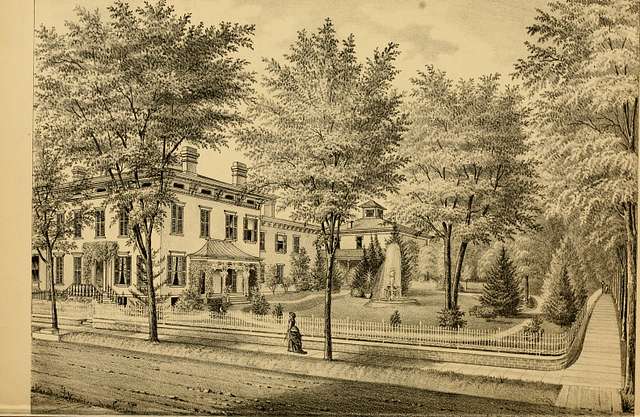
This essay was originally published in the 1947 OCHS Yearbook. Please note that this essay was published over 80 years ago. While still useful for general education, language may be outdated and at times offensive. The Oswego County Historical Society does not stand by the language used in this essay. All photos were added in 2026 when this article was uploaded to the web. To view the original document, please visit NYHeritage.org.
Paper Given Before Oswego County Historical Society at Oswego November 18, 1947 by Frederick W. Barnes, Vice President of the Society.
To begin with, what is a Street? According to the Dictionary “a public highway in a city or town lined on either side with houses” is a street. Nevertheless we have in Oswego, at least one public highway, which has no houses on it and yet they call it a street and it was named some years ago. They call it Eslaf street and it extends from No. 85 Hamilton to No. 314 on the Hall Road. If we take the word Eslaf E.S.L.A.F. and spell it backwards we have F.A.L.S.E. False, so it is really False street spelt backward.
In Montreal there is an old map of Oswego which shows about 70 log cabins or huts as occupied by our early Fur Traders. These were built in two parallel rows with about 35 cabins on each side and between them was a lane on which they faced. This lane may be considered as Oswego’s first attempt at street building. The topography of our lake front has changed somewhat since the old map was drawn. The original highway has not survived until our day, although Front street which extends from the harbor to West Schuyler street might almost be considered an extension of Fur Traders Lane.
Oswego was finally evacuated by the British on July 15th, 1796. Prior to that it was a fur trading center and a military post. After the evacuation it gradually acquired new interests which brought new people here and these new people had to have places in which to live and to do business. Someone may have appealed to the authorities in Albany, for in the year 1797 the State Surveyor General, Simeon Dewitt, sent one of his assistants here; a surveyor by the name of Benjamin Wright. This man had previously been in the employ of George Scriba, the great land holder, and as he was familiar with this locality he was selected to lay out the streets for the village of Oswego. Although the job of surveying the streets could be left to a subordinate, the seemingly more important task of naming them was reserved for the Surveyor General himself. Those thoroughfares which ran North and South were named as at present, 1st, 2nd, 3rd, etc., but those extending East and West received entirely different titles from those which they bear today.
Streets Receive Classical Names
General Dewitt apparently must have received a classical education for he went to the heavenly spheres for the names of 15 of Oswego’s streets. The northernmost thoroughfare was called in 1797 Aquila street. It was almost an eastern extension of what is now called Bronson street which then ran through to the river but was later closed up. As extended to the East side it was first known as East Aquila but we now call it Mitchell street. Still referring to the East side there is North of Mitchell a short street originally christened Auriga but now called Dewitt. In between Dewitt and Mitchell there is another short street once named Orion but since changed to Mercer. Returning to the West side of the river South of Aquila street the ancient and modern names are as follows – Lyra street now Van Buren; Aries street now Schuyler. What is now Seneca was then called Taurus. Gemini street is now Cayuga and Cancer street is now Bridge. (What an awful name for our principal thoroughfare, Cancer street!) And it bore that name for 40 years. Leo street is now Oneida. What was then called Virgo has been changed to Mohawk street and at the same time Libro was changed to Utica. The Albany street of today was once known as Scorpio. Sagittarius is now Erie. What was once Capricornus street has been shortened to Niagara and Aquarius changed to Ohio. The names seemed to get worse the farther one got away from the Lake. Surely it was not Surveyor General Dewitt’s fault that Oswego did not become a celestial city. Some of these classical names were to be found on the West Side only. Others were confined to the East Side but the majority were in evidence on both sides of the river.
Oswego Spreads Out
The British captured Fort Ontario in 1814 but even the terrors and privations incidental to war did not check an important movement toward the development of Oswego. It was in this same year 1814 that a surveyor named John Randall came here from Albany to remeasure the State Reservation on the East side of the river and to lay off 100 acres in streets and village lots. Randall’s instructions were to obey the law designating the bounds of the Reserve which directed that the Southern boundary should begin a mile from the mouth of the river and run thence a mile at right angles with the course of the stream. Surveyor Randall, however, managed to make the distances and angles differ from those established by his predecessor or Surveyor Wright. The new lines laid down by Randall encroached seriously on some adjoining farm lands previously purchased. Anxiety was caused to these purchasers and several delegations were sent to Albany to obtain if possible a restoration of the old lines. The authorities finally decided to ignore the changes and continue on the original bases.
In laying off and naming the streets in the new East Side Tract, Surveyor Randall followed the same system that had originated on the West Side. The streets parallel with the river were named East 1st, East 2nd, etc., while Aries, Gemini and Taurus were extended across to the East Side. By 1837 the people of Oswego had become thoroughly disgusted with their classical street names. To the mind of the ordinary villager there was something uncanny in such names as Aries, Taurus, Capricornus or Sagittarius and even if the average villager had known enough later to translate these appellations into Ram street, Bull street or Crab street, it would not have helped the situation materially so in 1837 the village fathers responding to a general demand rechristened those streets which ran East and West. Their first idea was to take Indian names for those thoroughfares which were located in what was then the centre of the town; hence we have Oneida, Mohawk, Cayuga and Seneca. Four of the five nation’s tribal names were thus accounted for but there was yet another (Onondaga) and tradition has it that the village fathers planned to change Cancer street to Onondaga street. Tradition further reports that the people did not want their principal thoroughfare called Onondaga. The name was too long, too awkward. There was but one bridge across the Oswego river in 1837. It connected East Cancer street with West Cancer street. Nearly everybody thought of Cancer street as the street of the bridge. Why not call it Bridge street and be done with it? So as is nearly always the case in this country of ours public opinion could not be denied and the street was officially designated Bridge street.
Streets With Indian Names
Of the 152 streets which form the ground plan of our city only eight bear Indian names: Erie, Ohio, Ontario, Niagara, Seneca, Cayuga, Oneida and Mohawk. Four are foreign – Albany, Dublin, Utica and Syracuse Avenue. Ten others are feminine as follows – Arabel, Catherine, Dorcas, Ellen, Elizabeth, Paloma, Minerva, Ruth, Naomi and Mary. You may remember that the distinguished actor and composer, the late George Cohan wrote a song in which he said that “Mary was a grand old name” for a woman so it must be good enough for any street. Seven other thoroughfares have masculine titles – John, Edward, Merrick, Orville, Governor, Gregory and Walter. Still another seven were named after trees – Ash, Cherry, Chestnut, Elm, Walnut, Maple and Willow. It is reasonable to assume that in the case of one or more of the last named group the street at one time may have been distinguished because of the trees of some particular kind which bordered it but if this were the case nothing of importance seems to have survived into our day.
Ten Location Streets
Ten streets have location names. By that I mean that the name indicates proximity to something of importance on our city map or else suggests its relative position as regards other streets. Such names are Bridge, Division, Center, Front, Lake, Water, Market, Prospect, St. Paul streets and Hillside Avenue. Liberty street is in a class all by itself. Every American city should have a Liberty street and Oswego has had one for a long time. We have now accounted for 43 names out of 152. Another 34 more or less have always borne numbers instead of names. Of the numbered thoroughfares 8th street seems to be the most popular. There are three 8th streets in Oswego, West 8th, East 8th and South 8th. South 8th is an extension of West 8th. It begins at 158 Ellen and runs in a southerly direction to the city line.
There are about eighty other streets to be considered and in nearly every case the name is that of a man who was at one time prominent either in local or national affairs. Among these is that of the enemy, the Marquis de Montcalm. We just had to have a Montcalm street and although the Marquis did fight against us, he was a gallant soldier and came to a dramatic end only three years after his victorious assault upon Oswego’s forts.
Streets In Alphabetical Order
From this point let us take the names of Oswego’s streets in their alphabetical order. Babcock street was named after a family prominent in Oswego through several generations. Some of us remember Bronson Babcock, one of the last to bear that name. When the State Normal school (now the Teachers College) moved to its present site, a man named Franklin Bayliss came here from away and started to develop the land adjacent to the school. His idea was that a good many homes would be needed by Oswego people connected with the school and although the development may not have been as extensive as Mr. Bayliss expected, nevertheless people did buy lots and will undoubtedly build on them when materials and labor are available, hence Bayliss street.
Probably the most distinguished man who has ever lived in Oswego was Alvin Bron son and it is fitting that a street should be named after him. Bronson street begins at No. 18 Montcalm and extends West to Liberty street. Some of Oswego’s most stately residences were built either on or adjacent to Bronson street. Our distinguished fellow member, Dr. Lida S. Penfield has already given us a paper dealing with H. C. Bunner, the popular novelist and his family. The Bunners lived in Oswego at one time which accounts for Bunner street. Members of the Burt family (spelled BURT) came to Oswego before the year 1800 and their descendants are with us today, having lived here ever since. It is doubtful if any other family has such a record and explains why there is a Burt street. Not so very many years ago, Oswego had a Mayor by the name of Conway. It was during Mayor Conway’s administration that a block of modern residences was erected on the Oneida Street State Road beginning at East 12th and extending to East 13th. The short street which connects these houses is called Conway Terrace. When Cook street was named whoever was responsible for the christening must have had in mind the late A. G. Cook, one of Oswego’s prominent business men who was very active here 70 years ago.
Origin of “Draper” Street
When it was decided to build a new Normal school in Oswego on a different site there was some difference of opinion as to where it should be located. Andrew S. Draper, at that time Superintendent of Education for the State of New York, acting in conjunction with the local board, was entrusted with the responsibility of selecting the site. The members of the local board either rightly or wrongly were of the opinion that Mr. Draper was not very friendly to Oswego and that there was danger he might hold up the appropriation if he could find an excuse for so doing. So when Mr. Draper met the local board the members asked him what was his choice and when he named the present location the others promptly acquiesced without any apparent difference of opinion. That is the way the story was told to me by a man now dead, but who at that time was a member of the local board. As far as I know everybody now agrees that the present location could not have been improved upon. Oswego retained its beloved Normal school destined to even greater usefulness as a State Teachers College and Mr. Draper got his reward when we named a street after him.
Duer Street
The next street name taken alphabetically is Duer. Very few Oswegonians now living ever heard of the Hon. William Duer although one of our streets bears his name. He was born in New York City, was educated at. Columbia and for a while practiced law in New Orleans. From there in 1835 Mr. Duer moved to Oswego. We do not know where he lived while here but we do know that he entered into partnership with Leander Babcock, another lawyer, and that their office occupied a portion of the site of the present Palladium building. In 1840 Mr. Duer was assemblyman from Oswego County and from 1847 to 1851 he represented this locality in Congress. In 1852 he went to Chili as Minister Pleni potentiary. The Honorable Mr. Duer came to Oswego not simply to practice law but also because he considered this locality a promising place for real estate investment and at one time he was the owner of considerable local property.
We were rather tardy in recognizing the claims of one of America’s greatest statesmen but we finally did call a street Franklin after the Benjamin of that time. We are not going to repeat any of the complimentary things which have been said about Gerrit Smith. A very complete sketch of his life was contained in a paper which was read before this society a few years ago. Suffice it to say that he was one of Oswego’s benefactors and he received the unusual honor of having two streets named after him for Oswego boasts of a Gerrit street and also a Smith street.
Hamilton’s Gore
Many residents of Oswego County have at one time or another heard of the Hamilton Gore, a tract of land largely incorporated into the city of Oswego. This piece of land was owned at one time by George Scriba but in 1804 it was conveyed by him to others after which the title to the property was transferred by foreclosure of mortgage to one John Lawrence who at that time was a U. S. Senator from the State of New York. Associated with Senator Lawrence in this transaction was the eminent Alexander Hamilton and a man named John Church. Because of Hamilton’s participation the parcel of land in question was afterwards known as Hamilton Gore or Hamilton Tract and three of our thoroughfares respectively, Hamilton street, Lawrence street and Church street were named after the three land holders.
The names Herrick, Hubbard, Judson and Lathrop, were bestowed upon our streets because in each case the name was that of a man prominent in his day in Oswego civic or industrial life. To begin with William H. Herrick built the car shops, a portion of which is still standing on the West Fifth Street Road. When Mr. Herrick built his own home he constructed the largest frame residence for a single family that our city has ever possessed. Part of this edifice is still standing on West Seneca street between Sixth and Seventh. Joseph B. Hubbard was in the leather business and with his partner, Charles North, operated a large tannery at a period when this industry contributed substantially to Oswego’s development.
Judson Street
We have now come to the street named Judson. If Oswego had not already named one of its streets after John Worth Judson it would have been compelled in all fairness to name one after his son, William Pierson Judson. John Worth Judson was the engineer who surveyed the old harbor and after him came his even more distinguished son, William Pierson Judson, who followed in his father’s footsteps as far as our harbor is concerned and in addition spent much of his very useful life in the development of other projects some of which were far from Oswego. Some of us who are here tonight knew William Pierson Judson and it was a privilege to know him. This Historical Society is particularly indebted to Mr. Judson because he gave much of his time and some of his substance to enrich the work in which we are engaged.
Lathrop street was named for the late Stephen Lathrop who built and occupied with his family the fine old stone residence across the street from the George B. Sloan mansion. This Lathrop house is now the property of Leonard Amdursky and stands today a monument to the dignified and enduring craftsmanship of the period in which it was built. The fine old house was set in the midst of grounds so spacious that they were known as “Lathrop’s Grove” and were the scene of many a picnic and an occasional garden party.
Recalls Anecdote
Lyon street, sometimes called East 9th street, extends from 118 East Seneca street south to East Cayuga street. I never hear Lyon street mentioned but what I think of that captain of industry, the late John E. Lyon. Mr. Lyon was a member of the firm of Penfield, Lyon & Co., one of the best known business organizations that Oswego has ever possessed. Mr. Lyon was the man who paid $500 to have the Battle Hymn of the Republic sung in old First Presbyterian church. This incident occurred during the Civil War period 1861 to 1864. Mr. Lyon was both a staunch Presbyterian and an ardent patriot. The pastor of the church at that time was suspected of being a Southern sympathizer and at any rate patriotic airs had not been as much in evidence as Mr. Lyon thought they should be. Lyon street, however, was named after James Lyon, the father of John E. Lyon.
One of Oswego’s shortest thoroughfares is called Market street. Half way between Bridge and Cayuga streets, it connects West First with Water street. It owes its name to its proximity to Market Hall, the most interesting building now standing in Oswego. Those of you who were fortunate enough to hear Miss Marian Mahar deliver her scholarly address on the subject of The Market Hall will need no further explanation.
There is a McWhorter street named after a family that was prominent here many years ago. The last one to bear that name was Mr. George McWhorter, a gentleman of the old school, a devout Christian and a zealous member of Christ Episcopal church. During a period of years it was Mr. McWhorter’s job to select the books which were added each year to our Gerrit Smith Library. Mr. McWhorter believed that the people should read more religious books, so the story goes that he bought nothing but theological works. Sad to relate, the library in consequence became very unpopular as comparatively few wished to draw the books.
A Tragedy of the Olden Times
Someone has said that “it is but a step from the sublime to the ridiculous.” If that be so perhaps it is but another step from the facetious to the tragic and with that in mind let us take up for consideration another family for whom a street was named. This time it is Murray street which begins at 442 West First and extends to the Kingsford Farm. Hamilton Murray the 1st came to Oswego in 1846 and bought a large tract of land just inside of what we now call the City Line – facing the West River Road. He named the property Greenvale and erected a fine stone mansion. The house is still there and up to a few years ago it was the residence of Mr. and Mrs. Leonard Johnson, who acquired the property about 1910. When the Leonard Johnsons lived there they called the property “Brinnington.” Hamilton Murray 1st was a useful citizen. He was one of the founders of the old City Bank, a director in the Oswego and Syracuse railroad and at one time president of the Oswego County Agricultural Society. He had several children, among whom was a son, Hamilton Murray 2nd and a daughter Martha. It was these younger Murrays whom I referred to when I said that it might be but a step from the facetious to the tragic. Hamilton Murray the 1st died in 1866 but his family continued to live at Greenvale.
It was in 1873 that Hamilton Murray 2nd and sister Martha undertook a trip to Europe. They embarked on the steamer Ville de Havre but this ill-fated ship collided in mid ocean with another boat and went down with the majority of those aboard. This disaster occurred on Nov. 23, 1873 but the news did not reach Oswego until Dec. 1, one week later, when it was learned that both of the Murrays and a Mrs. Piatt, also from Oswego, were among those lost. The other ship, the Loch Earn, the one which ran into the Ville de Havre, managed to keep afloat and was able to give those on the Ville de Havre some assistance, the only help which came from any source. Of the 317 souls aboard the doomed vessel, only 87 were saved whereas 230 perished. The Ville de Havre was considered one of the best passenger ships of her day and her loss has been rated as one of the worst marine disasters of the 19th century.
Story of Self Sacrifice
The foregoing paragraphs may be considered as the newspaper account of a tragedy as it was reported throughout the civilized world but there is something more which should be told, something perhaps which has never appeared in print. It seems that sometime after the tragedy one of the survivors came to Oswego and reported that after the collision the stricken vessel did not sink at once but remained afloat for a short time during which period the Murray brother and sister realizing that because of inadequate space in the lifeboats and other reasons that only a fraction of those aboard could possibly survive resolved that they would make no attempt to save themselves, but spent their last moments going about among the other passengers comforting them and setting an example of extreme fortitude under the most trying of circumstances. I was told this by my parents when I was a little child and have never forgotten it.
Named For Military Heroes
Mercer street and Mitchell street both commemorate soldiers who each in his turn fought bravely to defend our forts against overwhelming odds. Col. Mercer was the ranking British officer in 1756 when the French under Montcalm captured all three of our forts. Col. Mercer was killed in that action. Sixty eight years later, in 1814, it was a Col. Mitchell who commanded the Americans when an English fleet under Admiral Sir James Yeo bombarded Fort Ontario from the lake. The English outnumbered us nearly 15 to 1 and Col. Mitchell was compelled to withdraw his small garrison but not until he had made a stout resistance. We have now arrived at Midland street. The name Midland undoubtedly reflects the Midland Railroad, that unfortunate corporation which promised to do so much for Oswego and for which Oswego went so heavily in debt. When I was a small boy the older people round about where I was had a great deal to say about Midland bonds. Our city had been bonded for a very large sum to help pay the cost of constructing the Midland Railroad and each year our taxpayers were compelled to pay the carrying charges on these bonds. Munn street was named after Stephen Munn, who in 1817 bought 3,394 acres of land within the present confines of Oswego County.
Holds Record As Office Holder
Next in turn we must pay our respects to a man who, like Gerrit Smith, was big enough to have two streets named after him. We refer to the Hon. Orville G. Robinson and we have both an Orville and a Robinson street. Mr. Robinson was a distinguished lawyer and a man of affairs. During his long life he held more public offices than any other man who has ever lived in Oswego County. Beginning as a Justice of the Peace in the town of Mexico, Mr. Robinson was successively Town Clerk for Mexico, Surrogate for Oswego County, Member of Assembly for the Oswego District, District Attorney, Member of Congress, Recorder of the City of Oswego, Speaker of the Assembly for the State of New York and Collector of the Port of Oswego or nine offices in all. Mr. Robin son, however, could not be called an office seeker. This was a case where the office sought the man.
There are several reasons why we should have a Schuyler street but I will mention but one—the officer who fought under Col. Mercer in 1756 when the French captured the forts was a Lt. Col. Schuyler. We have come to Scriba and no one in this audience should need to be told why we have a Scriba street. George Scriba, who at one time owned all of the land (about 500,000 acres) from the Oswego River to the Oneida River from Lake Ontario to Oneida Lake. While they were about it why they did not pay him proper respect by naming one of our principal thoroughfares after him? Scriba street has but three houses on it and it extends from 223 East Second to 204 Syracuse Avenue.
Sheldon Avenue comes next and here again we have an instance of the name honoring the street rather than the street honoring the name. I shall not attempt to give even a brief biographical sketch of Edward A. Sheldon whose name more than any other Oswego name is associated with public education.
The Elusive Tallman
Up to this point with exception of Duer street already referred to it has not been difficult to find the reason for the choice of names but with Tallman street it was different. Nobody now living in Oswego appears to have ever heard of anyone by the name of Tallman and yet on the face of things it did seem that there must have been some reason for calling one of our important residential streets (Tallman street boasts of 166 houses) by that name. There was a George F. Tallman. After almost giving up in despair I accidentally ran across his name in an old newspaper which led to something tangible. George F. Tallman was a New Yorker with an office on Wall street. It is probable that at one time he owned more of Oswego’s land than anyone who has ever lived with the exception of course of the almost fabulous George Scriba and the possible exception of Stephen Munn.
In the “Oswego Commercial Times” for June 20, 1863, George F. Tallman had an advertisement in which he offered for sale at a public auction to be held on Feb. 10, 1863, 145 lots all located in or contiguous to the City of Oswego. One lot was described as being 1 1/2 acres in extent and two others were one acre each.
Van Buren Street
Turrill street was named after Judge Joel Turrill who in 1831 represented this district in the State Assembly. From 1833 to 1837 he was our Member of Congress after which he went as U. S. Counsel to the Sandwich Islands, now known as Hawaii.
Van Buren street is in honor of Martin Van Buren. The name has both a national and a local significance. Lot No. 6 of the Military Tract now forming the Western part of Oswego, had been a subject of litigation in the courts ever since its having been granted by the Land Commissioner. Martin Van Buren, afterwards 8th President of the U. S., was counsel for one of the claimants. In 1822 the legal battle was finally decided in favor of Mr. Van Buren’s client. This tract of land was not then of much value and the cost of litigation was greater than it was supposed to be worth. Mr. Van Buren, however, consented to accept it in payment of his services and the title to the land was therefore transferred to him. It has ever since been known as the Van Buren Tract. Although as just noted this land was at the time of the lawsuit of small importance it steadily grew in this respect because in 1895 its value was 1,000 times greater than it was originally appraised at. My authority for this startling statement is to be found in “Churchill’s Landmarks of Oswego County.”
Varick street was named after Abram Varick, another New York capitalist who came to Oswego about 1827. It was he who financed the Varick Canal project, a construction which has contributed greatly to the welfare of our city. There are probably 1,000 more thoroughfares in the U. S. which have been named after the father of his country, so no one should be surprised to learn that Oswego has a George Washington Boulevard. This avenue which forms the Eastern approach to the State Teachers College is lined on either side by trees which were planted in memory of Oswego veterans who lost their lives in World War I. Each tree is marked with a boulder on which is the name of one of these veterans. In 1822 the Oswego Cotton Mfg. Co. was incorporated and one of its directors was an A. J. Yates. Apparently the village fathers had this man in mind when one of our streets was named Yates Avenue.
Fish Names Suggested
Beginning with Babcock street and ending with Yates Avenue we have now considered in alphabetical order nearly all of those streets that were named after individuals or families. You may be relieved to learn that we have now come to almost the end of our subject but before asking for my discharge, either honorably or otherwise, I beg your indulgence for a few more moments while I tell you about a mysterious map which was at one time in the possession of your society but which has since disappeared. About 50 years ago there lived in Oswego a man named W. H. Kenyon. He was a lawyer and a good citizen. Many years after his death (I should say about 1935) one of his heirs brought to me a map which had been found among the late Mr. Kenyon’s papers. Your society bought this map for a small sum and it was added to our collection. It was beautifully printed in black on a glazed white paper or possibly linen surface. It was drawn to scale about 300 feet to the inch. Those streets on our East Side (for some reason the West Side escaped) which ran East and West were named after fish. I can remember but a few of these names but according to the map it was proposed to drop such titles as East Oneida, East Mohawk, East Utica, etc., and substitute such names as Trout street, Bass street or Mullet street. And to cap the climax it was printed in the State Engineer’s Office in Albany. Even if we should ever find this map (I have spent two evenings and one afternoon looking for it) the mystery of its origin will remain.
I knew the late William H. Kenyon. He was a serious minded dignified gentleman. It is not likely that he had anything to do with the making of such a fantastic map but it is more than probable that he did know something about who did it. If so, the secret appears to have died with him many years ago. The Chamber of Commerce wished to find a slogan that would describe Oswego and call attention to at least one of the things which make it different from most other cities. A number of suggestions were sent in but the one adopted was offered by our former townsman, the late George W. Bush. It went something like this: “Here’s to Oswego where every street begins at the water.” This may not be literally true but nearly all of our streets do begin either at the lake or the river. Allow me at this point to acknowledge my indebtedness to the following ladies for assistance dendered—To Miss Juanita Kersey for access to old newspaper files; to Miss Gertrude Thompson of the City Clerk’s Office for the loan of an interesting old scrap book, and to Miss Cynthia Beadle for the loan of her manuscript which dealt with a subject similar to my own. You have been most kind and considerate in your attention for which I thank you.