This essay was originally published in the 1957 OCHS Yearbook. Please note that this essay was published over 70 years ago. While still useful for general education, language may be outdated and at times offensive. The Oswego County Historical Society does not stand by the language used in this essay. All photos were added in 2026 when this article was uploaded to the web. To view the original document, please visit NYHeritage.org
Presented by Mr. Anthony Slosek, April 16, 1957
As cemeteries are important sources of historical data, this paper has been prepared so that the scattered facts may be brought together for future reference. Like all human institutions resting places of the dead have their periods of growth, fullness and decline. Time is relentless, and the burial place of one generation may become the playground of the next. There is no disrespect of the dead in this transition. Life’s aspect changes, and as generation follows generation, more room for the living is needed. A city grows up to the walls of a cemetery and spreads around the abode of the dead. Sooner or later the cemetery must go. Bodies are disinterred and moved to another resting place. The graves are filled up and the grounds are graded and seeded. Streets are cut through, or the land is set apart for public recreation or other purposes of the living. The habitations of the living replace the monuments of the dead. Soon there is no trace of the cemetery except in the memory of a few older residents.
Military Burials
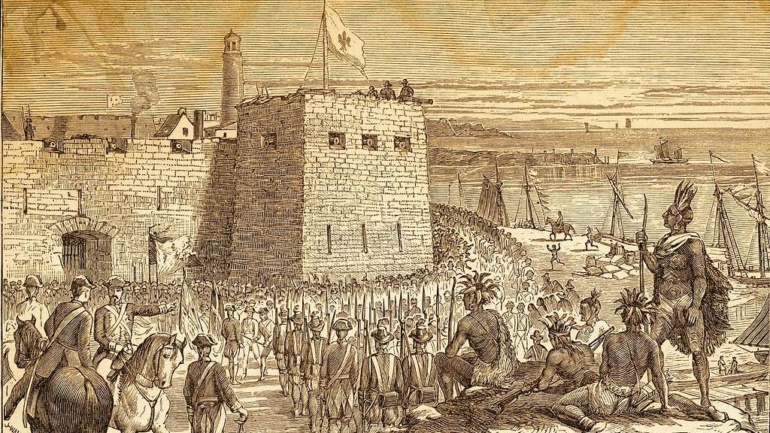
Oswego had long been occupied as a military post and resorted to by the inhabitants of the colony of New York for the purpose of traffic with Indians of Canada and the West. Fort Oswego and Fort Ontario was established in 1727 and 1756 respectively.
During the period of 100 years many interments had taken place but no spot seems to have been exclusively devoted to that purpose. Ancient graves had been found in all parts of both east and west Oswego, principally however on the bank of the Lake east of and in First Street. A spot also about eighty rods east of Fort Ontario and nearly the same from the lake in the eastern village was used by the British garrison as a depository for their dead from the erection of that fort until the evacuation in 1796. In the latter place many stones with rude inscriptions were standing in good preservation until after the War of 1812. There were also found in west Oswego as late as the 1830’s a number of stones bearing the date and name or initials of the occupant of the grave.
DeWitt Clinton visited this area in 1810 and left a vivid picture of this frontier land.1 He noticed that there was a burying ground near (Fort Oswego) and a few headstones. The only one inscribed has the following:—”Roger Cor Bert, 1742.” “When Indians are interred, their guns, kettles and wampum are buried with them. An Indian grave was dug up on the banks of the lake a few days ago. The bones were in a high state of preservation. His wampum and kettle were found with him but no gun. This interment must have taken place seventy years ago.”
On the 6th dav of May 1814 Oswego was attacked by the British fleet under the command of Commodore Sir James L. Yeo accompanied by a large land force under General Drummond, and after a sharp contest the American troops, about 300 in number, commanded by Colonel Mitchell, retreated, leaving the fort and village in possession of the enemy. They remained about 12 hours and departed.
In the battle there were nineteen of the enemy and six Americans slain. Among the latter, Lieutenant Blaney, U. S. A., a sergeant named Wright, and four privates. The enemy had two officers killed, one of them Captain Haltaway of the Marines. Their remains were taken away, but the bodies of the seventeen privates were left on the field.
During their stay the British collected the dead of both parties and put them in two piles in natural hollows of the earth and covered them slightly with turf torn up for that purpose. The battle ground and the place of burial was about sixty rods east of Fort Ontario. After the enemy had retreated, these mounds were overhauled and the bodies of the Americans taken out, enclosed in coffins, and interred with martial ceremonies on a rise of ground about eighty rods southeast angle of Fort Ontario. Lieutenant Blaney, however, was buried in the west village cemetery. Seven soldiers wounded in the battle subsequently died and were buried with their comrades.
After the close of the war there were interments of citizens made on a knoll at the southeast angle of East Third and Cayuga Streets.
Twenty seven unknown soldiers are buried in the little Fort Ontario cemetery. There are a few interesting headstones of stone presumably taken from the shore of the lake. On one of those is inscribed the name of George Fykes who served under the King with loyalty, and died October 24th, 1782, aged 32 years. Previous to 1861 no record of deaths was kept. Since that year a record of National Cemeteries has been required.
In 1947 the War Department issued an order to remove bodies from the Fort Ontario Cemetery but held the order in abeyance pending action on Congressman Fuller’s bill to transfer the site to the State. The cemetery was relinquished to the State the following year. Oswego County Historical Society and supervisors requested the legislation.
Rice Cemetery
The oldest cemetery in this vicinity besides Fort Ontario is that in Fruit Valley. The first interment, in February 1798, was that of one year old son of Asa Rice. Asa Rice came from Connecticut in October of 1797 and settled at the mouth of Three Mile Creek.
The old cemetery is on a knoll on the West bank of the creek about twenty rods below the bridge, route 104.2 Here lie the remains of 40 or 50 persons, which were marked by rude stones, all without inscriptions except five—Mr. and Mrs. Rice, two of their children and one other. In the days when they were deposited here there were no marble cutters who could carve their names, births ,or deaths on marble or granite, and no records were kept. Here, without doubt, were interred the fathers, mothers, sisters, brothers and friends of many of the hardy and energetic pioneers.
Around the graves of the Rices, some of their descendants have erected a substantial stone wall, laid in mortar, about four feet high, with stepping stones set in the wall to make access to the inclosure. The graves, four in number, are marked with gray slabs, probably of sandstone, plainly and correctly lettered. That of Mr. Rice is as follows: In Memory of ASA RICE, who died Aug. 22 1823 aged 69
The slab at the head of Mrs. Rice’s grave is uniform with that of her husband. She died August 11, 1819. Those of the children are also uniform except smaller in size. Horace died February 18, 1798, aged one year; Nathaniel died in January 1807, aged three. The other lettered slab of marble (now broken) is that of William Thompson, died June 6, 1815, aged 23 years.
The first person to be buried in the Union Village Rural Cemetery (Fruit Valley) was in 1820.3 This cemetery association was incorporated in March of 1860. Immediately next to the Rural Cemetery is a privately owned cemetery which has been in the possession of the Pierce family since the 1850’s.4 Many Oswego families have burial lots in the Rural Cemetery. In addition of these two cemeteries is the Irish Settlement Cemetery in Oswego Town where burials are now infrequent.
West Oswego Cemetery
In the original plotting of the Village of West Oswego by Simeon DeWitt, Surveyor General of the State of New York in the year 1796, a map whereof was filed in the Secretary’s office April 6, 1798.5 That part of the village which lies between Second and Fifth Streets and North of Aries, now Schuyler Street, and extending on the East line about 630 feet to within a few rods of the lake shore and on the West line about 970 feet to point also near the shore, was reserved and laid out as a cemetery. Except the south 100 feet thereof adjacent to Aries Street which was designated as a site for churches. In all subsequent sales of village lots by the State, this land was reserved. At the first settlement of the village by its inhabitants about the beginning of the nineteenth century, the occupation of the cemetery described above was commenced and the inhabitants continued there to inter their dead until the year 1828. This ground was never laid out or even enclosed nor was any order observed in making burials.
The part occupied was on the eastern edge a little south of the present intersection of Van Buren Street with Second and Third Streets; the only portion of which the soil was suitably dry and of sufficient depth. Some children were buried near the southeast corner at the intersection of Second with Schuyler Street, and several attempts were made to sink graves for adults, but the rock which formed the foundation of this part of the village was too near the surface.
Nearly half of the ground was an alder swamp and the western side a thick forest of chestnut, oak, and hickory. Prior to the year 1828 about 150 burials had been made. When it is considered that this number included all the soldiers who died at the garrison during the Embargo of 1808 and the War of 1812 as well as those persons who had been drowned in the harbor for thirty years, the salubrity of the climate and healthfulness of the place are manifest. One fact is worth of record. It is that from the month of May 1815 to October 1820, a period of five years and five months, there was not within the bounds of the village a single death of an adult except those occasioned by accident and only three children. The last death previous to this period was that of Mrs. Sophia O. Beach, wife of Samuel B. Beach and the first death after that period was that of Joseph Hooker formerly a merchant of the village but who had been spending the preceding summer in Oswego Falls as a clerk in a forwarding house where he was attacked with a fever, was brought home sick and died. During this period there were from 350 to 500 inhabitants in the village. Boswell Ellis, a young merchant, was taken sick and died while absent from home in 1819.
On the 10th day of January, 1827, the Legislature of the State of New York, upon the petition of the inhabitants, passed an act vesting the ground laid out as a cemetery in West Oswego by the Surveyor General in commissioners with power to sell the same and from the proceeds to purchase a more suitable site, level and prepare the same and remove thither the bodies previously interred in the old grounds.6 The commissioners named in the act were John Grant, Jr., George Fisher, Henry Eagle, Daniel C. VanTine and David Bailey.
The old cemetery was immediately laid out into 6 blocks and 35 lots and a map filed in the Clerk’s office of Oswego County. The lots were sold at auction in 1827 with the provision that one quarter be paid down and the residue in three equal annual installments.
In July 1827 the Commissioners bought from the State for $350.00 the blocks numbers 95 and 96 (Kingsford Park) on the west side with the immediate street comprising nearly six acres of land. In common with the whole southwest part of the village it was a dense forest. The Commissioners immediately cleared it of timber and leveled the west half. The Commissioners adopted a plan by which the parallelogram measured by the width of the west side was divided into four sections separated by broad alleys crossing each other in the center. The triangle lying on the south side of the plot was designated as the Potters field and was separated from the sections by an alley six feet wide. The whole of the four sections was laid out on the map in uniform manner in ranges and lots. Each range being 14 feet in width with intermediate alleys 4 feet wide and the lots 8×14 feet. Only the southwest section containing 12 ranges and 192 lots was actually laid out on the ground. The ranges were inclosed with a pine rail with red cedar posts sunk three feet in the ground and anchored. In the month of April 1828, the weather being extremely favorable, the removal of the bodies from the old cemetery to the new one was effected in about a fortnight’s time under the direction of Edwin W. Clarke. Every citizen who had friends to remove was permitted to select a lot. The strangers were interred in range number 1 of the west section of the Potter’s field. The southeast corner 16×14 feet of the southwest section was filled with the remains of persons who were known but who had no friends resident here. The whole ground was enclosed by a substantial stone wall and a stone hearse house built in the northwest corner in 1828. The Commissioners continued in charge of the cemetery. George W. Burt re placed D. C. VanTine and in 1836 they relinquished their trust to the Corporation of Oswego Village agreeably to an act passed May 10, 1836.7 By Chapter 116 of the laws of 1848 the City of Oswego was incorporated and succeeded to all the rights and property of the Village of Oswego.8
At the time of the transfer all the lots in the southwest section had been taken up. Early in the year 1837 the northwest section was laid out in a different plan, the ranges being 8 feet wide and the lots 14 feet long. The lots were ordered sold to those wishing them for five dollars each. Mr. Edwin W. Clarke was appointed superintendent. Much of the information about the village cemetery is taken from the superintendent’s register book now in the City Clerk’s office.9
The following items are taken from the register entries. The entries tell other tales than those of Lieutenant Blaney; for him the entry was “slain in battle.” That after Captain Turner of New York Militia from Camillus was the laconic note “fever” and after Sergeant Copp, of the same troops “shot by a sentinel.” That was in 1812. In the same year John S. Fitch was “drowned in Lake Ontario.” Henry Eckford Eagle, not a year old in 1820, was named by his father for the celebrated shipwright who had come to build the U. S. S. Brig “Oneida,” at Oswego, and the fleet at Sacketts Harbor in the 1812 War. In 1820 died James Cooley, father of Robert Cooley, a blacksmith, the entry reads, and on December 16, 1812, there was interred Mrs. Anna Adams, wife Dr. Truman Adams.
There were implied tales of tragedy in burial of Thaddeus Clarke, 56, “lost in the schooner Medora”; of Hazekiah Morse, 36, son of Jacob Morse, and Benjamin Dusenbury, 36, son in law of Jacob Morse, lost, also on the “Medora,” and all interred on November 10, 1835.
Colonel Eli Parsons, dead at 82, on September 25, 1830, had followed his wife, Mrs. Persis Parsons, 76, to the wooded knoll, by 23 days, and after the Colonel’s name was the natation “Revolutionary Officer,” and his grave and the resting place of his family thereupon become “free.” Marian Letitia Parsons, 31, a daughter, had died on September 6, 1813.
Orrin Munger’s entry in 1831 was “fell from factory”; Mrs. Anna Ford, 58, mother of Captain Augustus Ford. Mrs. Abigail Perry, mother of Eli and Philo Stevens, died May 27, 1837, at the age of 79 years, and Mrs. Catherine Howe, 37, wife of Major John Howe, on December 16, 1829.
William Boyd Bunner, 7, son of Rudolph Bunner, member of Congress, for whom Bunner Street was named, died December 9, 1828 and the Congressman followed in 1837. Another Revolutionary War soldier, Captain Edward Connor, early Oswego school teacher who first saw Oswego as the commander of a company in Colonel Marinus Willett’s expedition against Fort Ontario in 1783, 78, died July 2, 1831 and Mrs. Alida Woolsey, 85, died July 13, 1843 and was interred in the “new” cemetery. Her husband had been a Revolutionary War General, commanding along the border, and her son, Commodore Melancthon T. Woolsey, U. S. Navy, commanded at Oswego in 1812, and later on the Ontario.
Names recalling early Oswego manufacturing occur frequently, families of Burts, pioneers in water power and milling; Mrs. Mary DeZeng, mother of R. L. DeZeng who built the west side power canal, dying at 70, October 8, 1835; children of Elias Trowbridge; Major Theophillius Morgan, father of T. S. Morgan; Children of F. T. Carrington; Children of Luther Wright, pioneer banker; Mrs. Minerva B. Grant, wife of Hon. Joseph Grant; Daniel Hugunin, who died July 23. 1828 at 72; C. J. Burckle, for whom Burckle Street was named, and a score of others.
East Oswego Cemetery
In July 1827 blocks 92 and 93 (Fitzhugh Park) in East Oswego were reserved in the State sale and appropriated for a cemetery. It was immediately commenced to be used for that purpose, though very unsuitable. It was never enclosed and interments were made without regard to order or arrangement. On January 30, 1837 the Village Trustees resolved that the President in conjunction with the citizens of East Oswego petitioned the Legislature for an act authorizing the Board to dispose of the cemetery in East Oswego and procure and improve another in some other appropriate location and remove the bodies from one to the other. 10 Their petition was answered; for, on April 17, 1837, an act was passed authorizing the Corporation of Oswego Village to dispose of this ground and procure and prepare a more suitable site, and remove the dead.11 Yet nothing was done under this authority; for, three years later on March 23, a committee was appointed by the Board of Trustees to examine the present situation of the cemetery in East Oswego, and to ascertain what improvements were required, and the probable expense of making the same. Or in their opinion if it was advisable to change the location of the present cemetery, then to inquire whether a more suitable place of ground can be procured, and on what terms and also as to the disposal of the present site and report their doings herein to the Board at their next regular meeting, in order that the same may be submitted to the citizens of East Oswego at the ensuing annual meeting.
Not being able to uncover a report of the above committee, it is known that the cemetery was not abandoned; for, the Board on August 10, 1840 authorized the Trustees from East Oswego to contract for building a fence around the cemetery ground. It was so done at a cost of $180 but not until a tax of $200 was assessed on real and personal property of the East Siders. Evidently the residents of East Oswego wanted the cemetery improved and it was as a result of a petition by further tax levies in 1841 and 1846. The grounds were surveyed and laid out in lots and the resident citizens were allowed to select a lot for a sum of $4.00 which was spent for further improvements. In addition local taxes made possible the erection of a hearse house. Burials in cemeteries on both sides of the river were soon to become infrequent because other cemeteries were opened.
Abandonment of Fourth and Fifth Ward Cemeteries
With the gradual abandonment of the two public burying grounds steps were taken to organize a cemetery. As early as July 1849, a meeting was held at which James Piatt presided. Nothing was done, however, and it was not until July 18, 1855 that the Oswego Rural Cemetery Association (Riverside) was organized with the following trustees: John C. Churchill, John B. Edwards, Abraham P. Grant, Gilbert Mollison, Frederick T. Carrington, Thomas Kingsford, Samuel B. Johnson, Simeon Bates and William F. Allen. Every one of these founders now lie buried in Riverside. The site was originally a farm of 110 acres in the town of Scriba, owned by Thomas Robinson, and which was purchased for $5,600.
On September 25, 1857 the City of Oswego purchased of the Oswego Rural Cemetery Association a plot of ground in Riverside Cemetery for the gratuitous burial of such persons as shall be buried at the expense of the city and which was believed to be much larger than would be necessary for those interments for all the bodies which would become necessary to be removed at the expense of the City of Oswego.12
Since the commencement of interments in Riverside only a few interments had been made in the Fifth Ward cemetery and most of those in the Potter’s field and without any license from the city authorities. Friends and relatives had removed the dead bodies of the friends from the Fifth Ward cemetery to Riverside, St. Paul’s, St. Peter’s and other cemeteries near the city of Oswego and a very few of those interned in the Fifth Ward cemetery remained there. For thirty years prior to its abandonment, the Fifth Ward cemetery had no improvement made in it and had been almost entirely neglected and presented an unsightly appearance. The place had been for a number of years a trysting spot of disreputable people and a resort of the bad element of the city, it was alleged.
Agitation for the abandonment of this cemetery continued for some years. It was argued that the unsightly burial ground, a disgrace to the neighborhood, would become a beautiful park in a rapidly improving neighborhood. It would be sanitary, inexpensive and double the value of the real estate in that section of the city and make all real estate there abouts very desirable as building lots. Mr. Thompson Kingsford offered to convert the grounds into an elegant park in return for the stone in the cemetery wall.
Mr. S. M. Coon introduced a bill in the Assembly in January 1888 to convert the Fifth Ward cemetery into a public park. Everything bid fair for an early consummation of that very desirable end but the gentleman who represented the city in the Assembly at that time came home and was severely denounced by a citizen and he immediately allowed the bill to become as dead as any of the bodies the bill proposed to remove. Pressure was again applied and the bill passed the Assembly. The East Siders petitioned the Common Council to include the Fourth Ward cemetery in the bill and the favorable action of the Common Council caused the bill to be changed to the cemetery.13 With the assistance of Senator Sloan the bill became law on April 5, 1888.14 A notice published by the city clerk informed the people that the city would disinter dead bodies from the Fourth and Fifth Ward cemeteries after the time limit set by the state law. Relatives and friends could remove bodies before that time.
Removals were made in November and December 1889. The dead bodies were sent to Riverside, St. Paul’s, St. Peter’s, Rural and elsewhere and the number of removals, known and unknown, totaled 1025. Translation of the cemeteries into playgrounds soon followed and in 1928 the playgrounds have been utilized as educational centers. At that time Kingsford and Fitzhugh Park schools had been erected, an excellent monument to the generations that had gone before.
St. Paul’s cemetery on the lake shore was opened in 1853 and St. Peter’s on the East River Road was incorporated on May 2, 1880 although burials took place as early as 1871.
The division of Archives and History, New York State Education Department, published a bulletin (July 1956, number 1442) of selected New York State laws relating to cemeteries. This pamphlet contains excerpts of laws that relate to the establishment, maintenance, preservation and abandonment of cemeteries. It will be of interest to all persons who are seeking information, or are concerned, about the location and commemoration of deceased civilians and members of the Armed Forces.
Footnotes
1. William W. Campbell, The Life and Writings of DeWitt Clinton, (Baker and Scribner, 1849).
2. Information obtained by a visit to the cemetery.
3.Information obtained by a visit with Mr. A. C. Pease. Mr. Pease (now 93 years of age) has records of the cemetery.
4. From records in possession of the Pierce family.
5. Copy of map is here included.
6. Laws of 1827, Chapter 5. Letters Patent dated October 15, 1833 were given to the commissioners.
7. Laws of 1836, Section 20.
8. Laws of 1848, Chapter 116.
9. In the handwriting of E. W. Clarke.
10. Proceedings of the Board of Trustees, 1828-1848.
11. Laws of 1837, Chapter 225.
12. Deed dated September 25, 1857; recorded in Oswego County Clerk’s office January 3, 1863, Book 94 of Deeds p. 76 and 77. The plot cost $600.
13. Copy of petition can be found in Bradley B. Burt’s Scrapbook, Vol. III.
14. Laws of 1888, Chapter 106.