This essay was originally published in the 1970 OCHS Yearbook. Please note that this essay was published over 55 years ago. While still useful for general education, language may be outdated and at times offensive. The Oswego County Historical Society does not stand by the language used in this essay. All photos were added in 2026 when this article was uploaded to the web. To view the original document, please visit NYHeritage.org
Author: Colonel H. Edmund Bullis, U. S. Army Retired, Oswego High School Class of 1905
Due to the interest and generosity of a few Oswegonians, many fugitive slaves, through the “Underground Railroad,” reached Oswego in the 1850’s. The Negro civilian population reached its peak about 1855. The census that year listed 189 black males and 179 black females in Oswego County, of which 73 males and 67 females residing in the city of Oswego.
Hard times and the competition of cheap Irish labor made it difficult for blacks to obtain employment with the result that they soon left Oswego. There were very few blacks in Oswego at the time of the War Between the States.
My first memories of black people in Oswego, when my family moved to West Fourth Street in 1894, were coachmen for the Bond and Ames families, and the Benton family, who lived just one block from our home. These eight Negroes were the only ones of their race living here at the time.
Mr. Benton was the respected sexton of the Episcopal Church. I was a classmate of Mabel, one of his daughters, an attractive, popular girl. In later years her younger brother, Jay Benton was the leader of the outstanding dance orchestra in northern New York. All members of his orchestra were white. Jay was a popular and well known Oswego citizen. He played on the champion Oswego basketball team which had won national honors. Shortly after I left Oswego in 1910, a banquet in honor of this team, which had brought prestige to Oswego, was held at the Pontiac Hotel. And Jay Benton, one of the basketball heroes was not served at this dinner because he was a Negro. Although I was no longer living in Oswego, I never forgave the other members of the team for not leaving the Pontiac as a protest to this most unfair racial discrimination.
On March 26, 1908, the 2nd Battalion, 24th Infantry, a Negro regiment with a splendid record going back to 1821, arrived at Fort Ontario from their services in the Philippines. This Battalion consisted of Companies E,F,G,&H and was under the command of Major Elmore F. Taggart, whom I came to know very well many years later, when he, as a retired Colonel, was Mayor of the City of Baguio in the Philippines. On November 28, 1911, the Battalion was ordered from Fort Ontario to serve again in the Philippines.
Naturally a number of black families and black camp followers came to Oswego to be with the men of the 2nd Battalion. There were mixed feelings about this influx of blacks in Oswego as can be seen from the following article quoted from the Oswego Daily Palladium of December 21, 1911, shortly after the departure of the 2nd Battalion from our city.
“Oswego is fast losing the population which, for the past two years and a half, lent a touch of color to the throngs on the streets, and before another month has passed the colored soldiers and their friends who remained after the 24th Infantry from Fort Ontario will have gone. Hardly a day goes by but one or more leaves the city for more congenial climes and people and, with them and the departure of the troops, the “Black Belt” goes out of existence after two years of flourishing prosperity.
The “Black Belt” as it was named by the police, was that portion of the Second Ward near the Post which, by common consent, appeared to be set apart for houses where dwelt colored people, the followers of the troops, houses which were not in very good repair were taken over at high rental in that vicinity and for a time the place took on new life. The establishment of a settlement there made many of the older inhabitants move into other wards.
They were not much trouble to the police, these inhabitants of the “Belt” but whenever there was trouble in the city, it was generally in that locality. It was the scene of one murder, when Private Benny Lee murdered his sweetheart, and of numerous other stabbing affrays, many of which were never investigated by the police.
It must be said, however, that the inmates kept well to themselves and resented the intrusions of white people looking for trouble, and there was more than one row which had the neighbors talking for weeks.
They are leaving now, for the last of this month will see the leases on many of the houses expire.
It has been estimated that when the colored battalion was at Fort Ontario there were over 100 colored women in this city and they were certainly gorgeous dressers. Violet bonnets and flaming dresses are in the minority now and the merchants in retail business miss them, for both soldiers and the others were good spenders and bought only the best.”
In a very short time after the 2nd Battalion was ordered away from Fort Ontario, the black population of Oswego almost disappeared. There were less than a dozen blacks in Oswego during the following thirty years.
Many years passed and a much larger Negro military unit, the 309th Coast Artillery National Guard Regiment from Harlem, New York City, was stationed a t Fort Ontario. They arrived in January, 1941, and were ordered to Camp Edwards in Massachusetts in September of the same year. All the personnel of this regiment, including the officers, were black, quite a change from the 2nd Battalion at Fort Ontario thirty years before, when all the enlisted men were black and all the officers were white.
In 1898 when I was ten years old, a Negro incident, not important to Oswego but of decided significance to the Bullis family, was the visit to Oswego of Booker T. Washington, the distinguished founder of Tuskeegee Institute in Alabama, which has played a most important part in the destiny of blacks in our country.
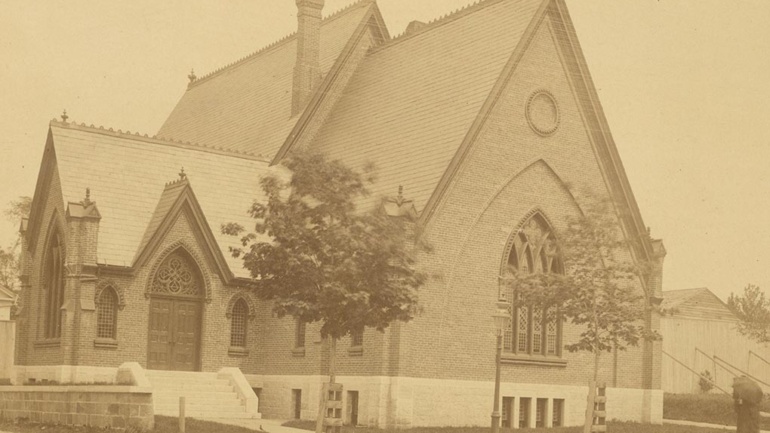
My father, George E. Bullis, a graduate of Oswego High School and Oswego Normal School, was superintendent of schools in Oswego and much interested in the Tuskeegee experiment. At that time Booker T. Washington had not written his classic, Up From Slavery. My father invited Mr. Washington to come to Oswego and deliver a benefit lecture for Tuskeegee at the old First Presbyterian Church.
Mr. Washington came and brought with him a black quartet from the Institute. The program was well received and of financial benefit to Tuskeegee. My father introduced Mr. Washington to the Oswego audience.
Booker T. Washington had dinner and stayed overnight with the Bullis family, the first time and perhaps the only time, a national celebrity had ever been entertained in our home.
I was to have dinner with Mr. Washington, my mother and father, and was warned only to talk in answering questions. Mr. Washington put me at my ease by enquiring about my progress in school.
My mother, wishing to enter the dinner table discussion said, Mr. Washington, I have read in the newspapers that a number of your students have left the Institute and enlisted in the army to fight our enemy, Spain. I hope they may make a splendid record for themselves and for Tuskeegee. Seventy two years have elapsed; however, I can distinctly remember Booker T. Washington as he said, “Madame Bullis, I note that you are a splendid home maker. On the second floor of your home I notice a sewing machine. Undoubtedly you have a knowledge of fabrics and you have learned that ‘ Fast Black Never Runs.’ I can assure you Madam Bullis, that these Tuskeegee students in the Army are fast black. They will never run. ”
Many years later a souvenir Booker T. Washington half dollar was minted by our government. For many years, I carried, as a good luck piece, one of these Booker T. Washington half dollars. I was proud to carry a coin depicting the face of someone I personally knew.
Oswego has never had integration problems in its schools. There have been very few black children in Oswego for well over twenty years. During the past school year there were no black pupils or black teachers in our public schools. However, on the Oswego campus of New York State University there were about 100 black students and three faculty members. This year, there are about 500 black students enrolled on the Oswego campus.
In the great migration of Southern blacks to the North after World Wars I and II, few if any blacks selected Oswego as their destination. This was logical for there were almost no blacks living in Oswego; there were relatively few job opportunities; wages were comparable low as compared with wages paid in Detroit and other large industrial cities; Oswego welfare funds were not liberally distributed to newcomers from the South; also the cold and snowy Oswego winters were not eagerly sought after by Southern blacks.